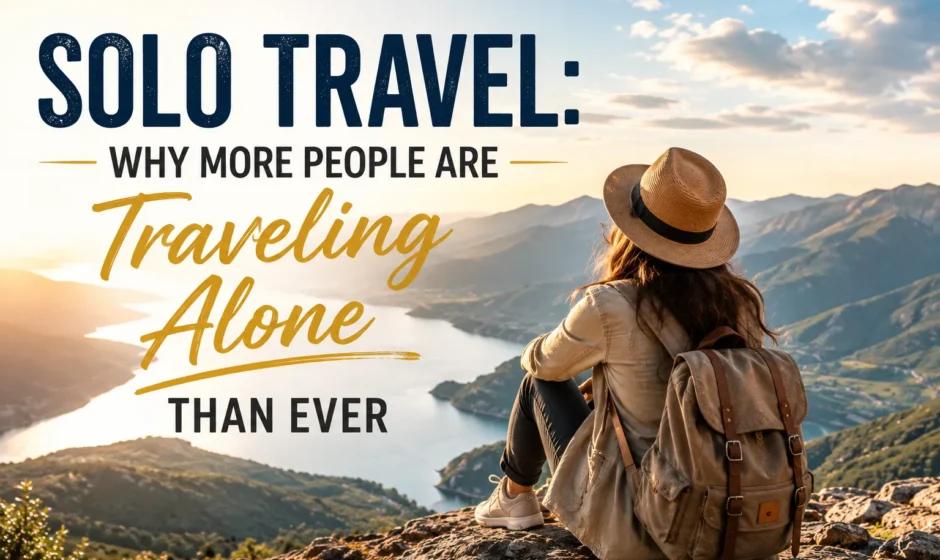

Solo travel has crossed a genuine threshold. What was once framed as a niche, slightly adventurous choice has become the dominant way a huge share of travelers — women in particular — now choose to see the world. Google Travel data shows solo female travel search interest at a 15-year high, and the numbers behind that surge are reshaping how the travel industry designs everything from tours to hotel rooms.
Just How Big Is Solo Travel Right Now?
The global solo travel market was valued at roughly $550 billion in 2025 and is projected to keep growing at 13-15% annually through 2033 — a pace that outstrips most other travel segments. Solo travelers now account for an estimated 18% of global tourism bookings, and 59% of travelers say they’ve taken at least one solo trip in the past five years. This isn’t a temporary post-pandemic blip; it’s a structural shift in how people choose to travel.
Why Women Are Driving This Trend
The single biggest story in solo travel right now is who’s actually doing it: women now make up an estimated 84% of solo travelers globally, according to this year industry surveys, with 72% of American women having already taken at least one solo trip — the highest rate of any country. This isn’t a marginal shift; multiple sources now describe women as the solo travel market itself, rather than a growing segment within it.
A few forces are driving this specifically:
- The “Me-Moon” trend — solo, often luxury or bucket-list trips women book for themselves rather than waiting for a partner or a wedding to justify the expense. It reflects a broader shift toward solo travel as a genuine lifestyle choice rather than a fallback option.
- Older women traveling bigger — women aged 35-75 are now planning solo trips averaging roughly $18,000 each this year, with solo female travel in this age group surging 131% since 2024. Many report bringing their own established personal-care routines rather than compromising, reflecting more experienced, higher-spending travelers than the stereotype of solo travel as a young backpacker’s activity.
- Women-only group travel — 21% of women plan to take a women-only group trip, an all-time high, as tour operators scramble to meet a level of demand that’s reportedly caught much of the industry off guard.
What’s Actually Motivating People to Travel Alone
Beyond demographics, the underlying motivations are worth understanding. Roughly 87% of women cite freedom and flexibility as their primary reason for choosing solo travel, and 78% describe it as an opportunity for personal growth and self-discovery — a genuinely different framing than travel-as-escape. Mountains are the single most popular destination type among solo travelers overall (18%), and 77% of solo female travelers specifically prioritize destinations with strong cultural and historical depth over purely scenic or resort-style locations.
Addressing the Safety and Loneliness Concerns
Safety remains the most significant barrier specifically for women considering solo travel: 63% cite personal safety as their main concern, compared to just 18% of men — a substantial gender gap that shapes both destination choice and trip planning. The most common specific worries are walking at night (59%), staying somewhere unfamiliar (51%), and navigating public transport (44%).
Loneliness is a related but distinct concern, and the data here holds a genuinely useful insight: loneliness worry peaks before departure and drops significantly once a traveler actually arrives at their destination. The real driver behind pre-trip anxiety, according to more detailed research, isn’t social isolation itself — it’s the burden of planning everything alone. Once underway, 71% of solo travelers actively seek out social connection on the road, and 78% report real gains in confidence as a direct result of the experience.
The Safest Destinations for Solo Travel
A consistent cluster of countries repeatedly tops solo travel safety rankings: Iceland, Portugal, Japan, Ireland, and Denmark lead most current indices, with Spain scoring 7.45 out of 10 on solo female safety indices — the highest of any non-Nordic country, and a big part of why 54% of solo female travelers consider Europe the ideal first solo destination for women. If you’re weighing options, Portugal’s strong safety ranking pairs well with Madeira’s status as 2026’s top trending destination overall, while Spain’s safety profile and pleasant autumn shoulder-season conditions make it a particularly strong first-timer pick if traveling outside peak summer.
Poland and Austria also appear consistently among top-10 safest destinations, alongside New Zealand and Switzerland for travelers looking further afield.
How to Plan a Solo Trip With Confidence
- Start with a top-ranked safety destination for a first solo trip — Portugal, Spain, or Iceland are well-supported choices with established solo traveler infrastructure.
- Consider a women-only group tour if full independence feels like too big a first step — these offer the personal freedom of solo travel with built-in social structure and safety.
- Front-load your planning before departure, since the planning burden — not actual isolation — is the biggest driver of pre-trip anxiety.
- Prioritize accommodation safety when booking — 19% of American solo travelers list this as their top booking priority, ahead of price or location convenience.
The Bottom Line
Solo travel isn’t a niche trend anymore — it’s a genuine structural shift in how a huge share of travelers, women especially, choose to experience the world, backed by a market worth hundreds of billions of dollars. The safety concerns are real and worth planning around seriously, but the data is just as clear on the other side: most people who travel solo come home more confident, not more isolated, than when they left.
FAQs
How many solo travelers are women?
Estimates vary by source, but this year industry surveys put the figure at roughly 84% of solo travelers worldwide identifying as women, with 72% of American women having taken at least one solo trip.
What is the safest country for solo female travel?
Iceland, Portugal, Japan, Ireland, and Denmark consistently top current safety rankings for solo female travelers, with Spain scoring highest among non-Nordic countries on solo female safety indices.
What is a “Me-Moon” in travel?
A Me-Moon is a solo trip, often a luxury or bucket-list-style getaway, that a traveler — predominantly women — books for themselves rather than waiting for a partner or a wedding to justify the experience.
Do solo travelers actually feel lonely while traveling?
Loneliness concerns peak before departure but drop significantly once a trip is actually underway. The real driver of pre-trip anxiety is generally the burden of solo planning rather than social isolation itself, and 71% of solo travelers actively seek social connection once on the road.
What’s the best destination for a first solo trip?
54% of solo female travelers consider Europe the ideal first solo destination, with Spain and Portugal frequently recommended specifically due to strong safety rankings and well-established solo travel infrastructure.