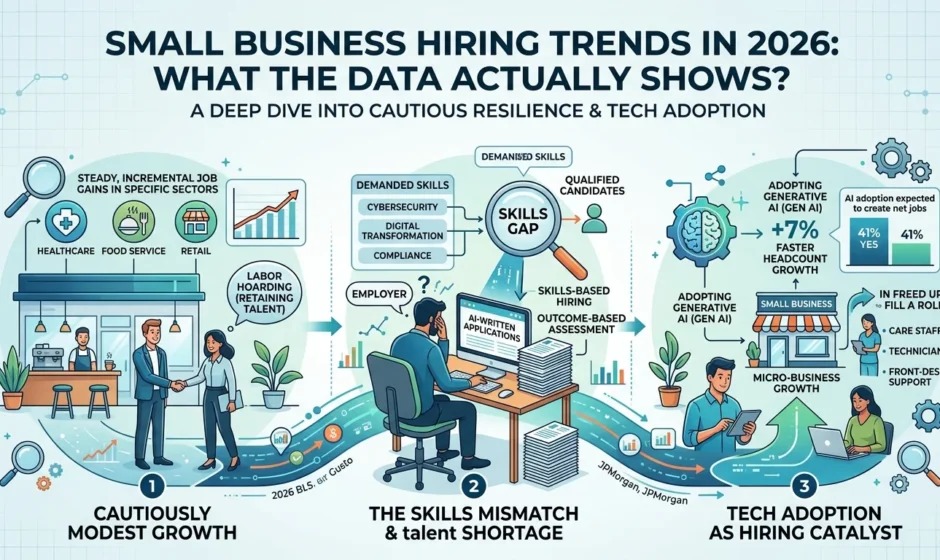

Small businesses are carrying the U.S. labor market in 2026. And struggling to staff up at the same time. Firms with fewer than 20 employees created more than 525,000 jobs in 2025 and added roughly 200,000 more in the first quarter of 2026 alone, according to ADP Research. Without that group, the U.S. would have seen a net loss of private-sector jobs last year.
Yet hiring has never felt harder for many of these same owners. ToperNews breaks down what’s actually happening in the small business labor market this year. And why it’s happening, what it means for how you staff your team. Building on the broader small business trends shaping 2026 covered elsewhere on this site.
The Big Picture: “Not Hiring, Not Firing”
The clearest way to describe small business hiring in 2026 is a cautious holding pattern. According to JPMorgan’s 2026 Business Leaders Outlook, only 12% of midsize businesses plan to reduce headcount this year. A notably low figure by historical downturn standards. At the same time, most aren’t rushing to expand either.
This isn’t a contraction. It’s a pause, and it’s showing up consistently across multiple data sources:
- The Bureau of Labor Statistics’ May 2026 report showed the economy added 172,000 nonfarm payroll jobs, with unemployment holding steady at 4.3%.
- Paychex’s Small Business Employment Watch put its national Jobs Index at 99.30 in January 2026, up just 0.04 percentage points from December.
- Gusto’s March 2026 SMB Jobs Report found small businesses added a net 119,400 jobs that month, the strongest single-month gain since 2022, led by healthcare (+24,200), food service (+17,400), and retail (+12,800).
The pattern across these numbers is consistent. Real, positive job growth, but at a measured pace rather than an aggressive expansion.
Why Does Hiring Feel Harder Even as the Market Cools?
Here’s the part that catches a lot of owners off guard: a cooling labor market hasn’t made hiring easier. According to NFIB’s March 2026 data, 32% of small business owners reported job openings they couldn’t fill, and among those actively hiring, 87% said they found few or no qualified applicants.
The reason comes down to a persistent skills gap rather than a shortage of applicants. SHRM’s 2026 Talent Trends Report, based on a February 2026 survey of 2,094 HR professionals, found that 68% still face challenges recruiting for full-time roles, and 53% say it’s gotten harder over the past year. When asked what’s actually missing, 80% of HR professionals pointed to the same thing. Candidates lacking systems and resource management skills judgment, decision-making, and complex problem-solving, not technical credentials.
The market has more resumes, but fewer candidates who can perform the job immediately without extensive ramp-up.
What’s Driving the Caution?
A few forces are shaping this “wait-and-see” hiring posture specifically for small and midsize businesses in 2026:
Policy and cost uncertainty. Ongoing changes tied to tariffs, labor regulations, and operating costs make forecasting difficult. For businesses tied to supply chains or hourly labor, even small cost shifts affect margins enough to delay hiring decisions.
Rising healthcare costs. Paychex’s own HR professionals report that persistent labor supply challenges and rising healthcare costs remain two of the most-cited pressures going into 2026, even as wage growth stays historically modest (2.68% hourly earnings growth in January 2026, largely unchanged since mid-2025).
“Labor hoarding.” Because rehiring is slow and expensive, many small business owners are choosing to retain existing staff through a slowdown rather than risk being understaffed when demand picks back up.
AI-driven productivity without headcount cuts. Many small businesses are using AI for scheduling, reporting, and customer communication — getting more output from existing teams rather than expanding headcount to meet demand, a pattern that connects directly to the broader AI adoption trend among small businesses and the rise of the SuperWorker AI Trends covered elsewhere on this site.
The Shift Toward Contract and Flexible Staffing
One of the clearest structural shifts in 2026 is the growing role of contract and flexible labor. Robert Half’s research found 45% of small businesses plan to increase contract hiring in the first half of 2026, using contractors to access specialized skills for specific projects without committing to full-time salary and benefits.
This shift also reflects a genuine generational change in what workers want. The American Staffing Association’s 2026 trends report notes that fixed, 35-to-40-hour-a-week roles are losing appeal, particularly among younger workers — pushing more staffing firms and employers to structure roles around gig-style flexibility rather than traditional full-time positions.
Why Retention Now Matters More Than Recruiting
With hiring this expensive and this difficult, keeping the employees you already have has become a higher-leverage priority than chasing new hires. Gallup research puts the real cost of replacing an employee at 40% of salary for frontline roles and up to 200% for leadership positions, once recruiting, training, and lost productivity are factored in.
That math changes the calculus for a lot of small business owners in 2026. A modest investment in retention better schedule predictability for hourly staff, clearer manager communication. A standardized onboarding process that gets new hires productive faster often costs far less than a single replacement hire gone wrong.
Practical Hiring Strategies for Small Businesses Right Now
- Use contract workers for specialized, project-based needs. This gives access to specific skills without the long-term commitment of a full-time hire — particularly useful during a period of genuine economic uncertainty.
- Fix retention problems before they become hiring problems. If you’re seeing turnover in hourly roles, look at schedule predictability and day-to-day manager communication before assuming you need to raise wages.
- Standardize onboarding. A consistent onboarding process shortens the time it takes a new hire to become genuinely productive, directly addressing the “resumes but not enough ready-to-perform candidates” problem employers are reporting.
- Evaluate for judgment and problem-solving, not just technical skill. Since HR professionals consistently name these as the hardest qualities to find, weighting your interview process toward them can meaningfully improve hire quality.
- Watch for signs hiring may loosen later in 2026. Several sources describe a general industry expectation that hiring could pick up in the second half of the year — worth factoring into longer-term workforce planning rather than only reacting month to month.
Staffing decisions this year also connect directly to service quality. A well-staffed, well-trained team is foundational to delivering the kind of customer experience that’s become a genuine competitive differentiator for small businesses in 2026.
Conclusion
Small businesses remain the engine of U.S. job creation in 2026, but the hiring environment they’re operating in is genuinely more complicated than a simple “good market” or “bad market” label would suggest. Job openings are real, wages are stable, and layoffs remain limited yet a persistent skills gap and real economic uncertainty are pushing more owners toward contract staffing, retention-first strategies. And cautious, deliberate hiring rather than aggressive expansion. Understanding this “not hiring, not firing” pattern and adjusting your own staffing approach accordingly is one of the more actionable takeaways from this year’s broader small business trends.
FAQs
Are small businesses hiring in 2026?
Yes, cautiously. Businesses with fewer than 20 employees created over 525,000 jobs in 2025 and roughly 200,000 more in Q1 2026, according to ADP Research, though overall hiring pace has slowed compared to prior expansion years.
Why is it hard to find qualified candidates even though unemployment is stable?
SHRM’s 2026 survey found the core issue is a skills gap, not a lack of applicants. 80% of HR professionals report the hardest candidates to find lack judgment, decision-making, and complex problem-solving skills, not technical credentials.
Should my small business hire contractors instead of full-time employees in 2026?
It depends on the role. Robert Half found 45% of small businesses plan to increase contract hiring in early 2026, largely for specialized, project-based work where a long-term commitment isn’t necessary.
What is “labor hoarding” and why are small businesses doing it?
Labor hoarding means retaining current employees through a slow period rather than laying off and rehiring later. Since replacing an employee can cost 40% to 200% of their salary (per Gallup), many owners see retention as cheaper than future rehiring.
Is small business hiring expected to improve later in 2026?
Several industry sources describe a general expectation that hiring could pick up in the second half of 2026, though this reflects broad industry sentiment rather than a confirmed forecast.