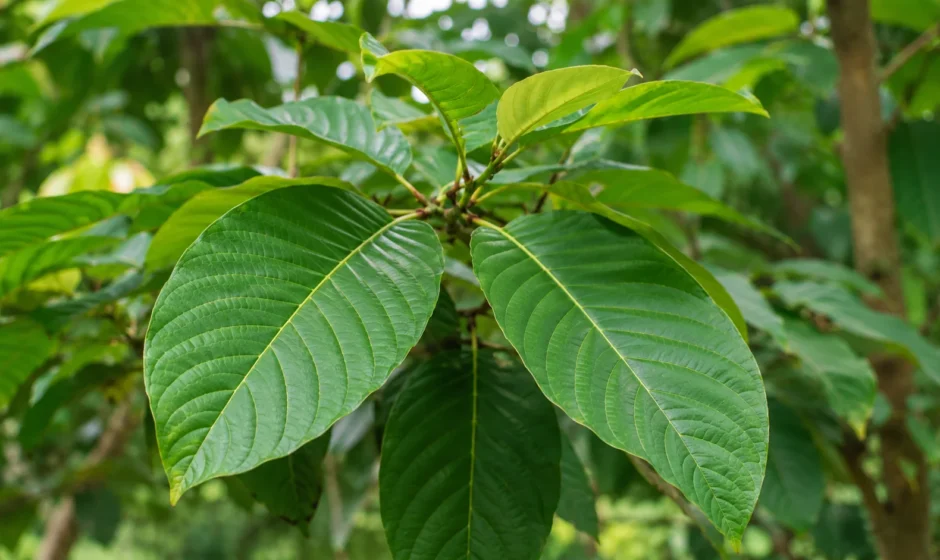

Kratom is the common name for Mitragyna speciosa, an evergreen tree in the coffee family native to Southeast Asia. Its leaves are dried and consumed in various forms, most commonly as a powder.
According to the National Center for Complementary and Integrative Health (NCCIH), two compounds are contained in kratom, which are mitragynine and 7-hydroxymitragynine. These compounds interact with opioid receptors in the brain. This is the pharmacological basis for most of kratom’s reported effects. It’s also why federal agencies treat kratom with the same caution applied to other opioid-receptor-active substances.
Modern commercial kratom products, sold as powders, capsules, teas, and concentrated extracts. Which are differ significantly from the traditional leaf-chewing practices kratom is rooted in. Concentration, processing, and purity vary widely between products, which matters for both effects and safety.
Where Does Kratom Come From? History and Traditional Use
Kratom has a long history of traditional use in Thailand, Malaysia, Indonesia, and Papua New Guinea. Where laborers and farmers reportedly chewed fresh leaves for energy during physical work. Similar to how coca leaves or betel nut have been used elsewhere.
Traditional preparation involved fresh or dried leaves, chewed directly or brewed as a tea. This differs meaningfully from the concentrated powders and extracts common in Western markets today. It can contain alkaloid concentrations well above what traditional use involved.
Kratom entered US and European markets gradually over the past two decades. Driven initially by online sales and, more recently, by wider retail availability in smoke shops, gas stations, and specialty stores. According to a 2023 SAMHSA National Survey on Drug Use and Health approx. 1.6 to 1.7 million people in the United States used kratom.
What Compounds Are Found in Kratom?
Kratom leaves contain more than 50 identified alkaloids, though only a small number have been studied in meaningful depth.
- Mitragynine is kratom’s primary alkaloid by volume. Research published in peer-reviewed pharmacology journals describes it as a partial agonist at the mu-opioid receptor. Which means it activates that receptor but generally with a ceiling effect, less intense than a full opioid agonist like morphine at comparable doses.
- 7-hydroxymitragynine (7-OH) occurs naturally in kratom leaf, but only in small amounts. NIH-affiliated scientists researched and found that when mitragynine is metabolized in the body after oral consumption. It converts partly into 7-OH. And this metabolite appears to drive a meaningful share of kratom’s pain-relieving effects in animal studies. This is also published in ACS Central Science.
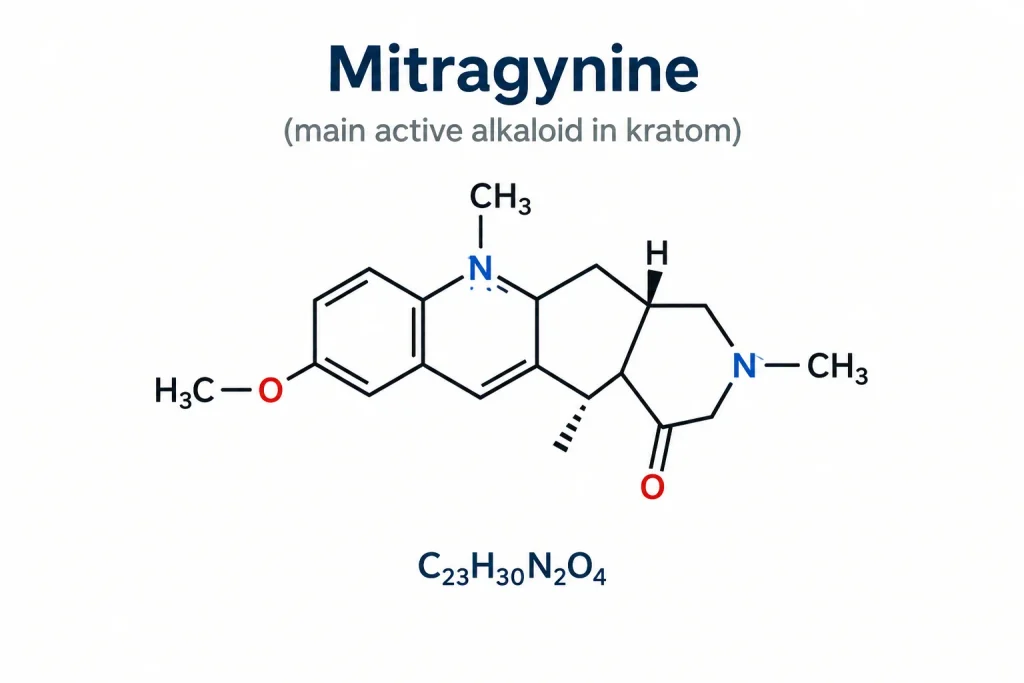
This distinction matters for current regulation. Concentrated, manufactured 7-OH products, sold separately from natural kratom leaf, contain far higher concentrations than occur naturally. And behave more like a potent synthetic opioid. This is the specific product category federal regulators have targeted for stricter control in 2026, not natural kratom leaf itself.
Researchers have identified other alkaloids beyond these two. This includes speciociliatine and mitraciliatine, with varying and still poorly understood activity at opioid and other receptor systems. Product alkaloid profiles can vary significantly between batches and vendors, which is one reason effects are inconsistent between products.
How Does Kratom Work in the Body?
Mitragynine’s partial agonism at the mu-opioid receptor is the best-studied mechanism behind kratom’s effects. Animal research, including studies reviewed in Frontiers in Pharmacology, has found that mitragynine produces little to no evidence of the dangerous respiratory depression associated with full opioid agonists. Even at doses many times higher than typical human use. A finding consistent with its “ceiling effect” as a partial agonist rather than a full one.
This is animal and laboratory research, not a guarantee of safety in humans. Particularly when kratom is combined with other substances or consumed in concentrated extract form.
Beyond opioid receptors, researchers have found evidence that kratom’s alkaloids may also interact with adrenergic, serotonergic, and dopaminergic systems. This more complex pharmacology may help explain why kratom can produce both stimulant-like effects at lower doses and more sedating. Opioid-like effects at higher doses, though the exact dose-response relationship in humans is not fully mapped.
What are the Effects of Kratom?
According to NCCIH, people who use kratom report both stimulant-like effects (increased energy, alertness, faster heart rate) and effects resembling opioids and sedatives (relaxation, pain relief, confusion).
It’s important to separate two categories here.
Reported effects come from user surveys, case reports, and self-report data. They describe what people experience but don’t establish a proven clinical effect.
Established effects would require controlled clinical trials in humans, which for kratom remain very limited.
At this time, most of kratom’s effects in humans comes from self-report and observational data rather than controlled trials. And NCCIH states plainly that research on kratom is still in its early stages.
Potential Benefits of Kratom: What Research Actually Shows
- Pain relief: This is the most common reason people report using kratom. Pharmacological research supports a plausible mechanism, mitragynine and 7-OH acting on opioid receptors. But human clinical trial data establishing kratom as an effective, safe pain treatment. It does not currently exist in a form the FDA has evaluated and approved.
- Opioid withdrawal management: Case reports and self-report surveys describe people using kratom to ease opioid withdrawal symptoms. This is an area of active, serious scientific interest. In 2026, the NIH announced it had cleared the way for a clinical trial of a purified mitragynine formulation. Developed by NIH and University of Florida researchers, specifically to study its potential as a treatment for opioid use disorder. NIDA Director Dr. Nora Volkow described the trial as a step toward expanding treatment options for opioid use disorder. This is a genuinely significant development, but it is a step toward formal research, not evidence that kratom itself is an approved or established OUD treatment today.
- Mood, anxiety, and energy: These are commonly claimed uses. But they rest almost entirely on anecdotal and survey-based reports rather than controlled clinical evidence at this time.
Across every claimed benefit, the same limitation applies. Current evidence is preliminary, and no kratom product is FDA-approved to treat any medical condition.
Side Effects of Kratom
Commonly reported side effects include nausea, vomiting, constipation, dizziness, drowsiness, dry mouth, sweating, and changes in heart beat which are based on case reports and toxicology surveillance. A pharmacology reference summarizing kratom-related emergency presentations notes agitation or irritability in roughly 23% of cases. And rapid heart rate in roughly 21%, based on published case series.
Most of these effects are uncomfortable rather than dangerous on their own. But they can signal that a dose was too high for that individual. That a product’s actual potency didn’t match its labeling.
Serious Risks and Safety Concerns about Kratom
The FDA states directly that it warns consumers not to use kratom because of the risk of serious adverse events. Including liver toxicity, seizures, and substance use disorder.
The FDA has also stated that in rare cases, deaths have been associated with kratom use. This is confirmed by medical examiner or toxicology reports.In most of these cases kratom was used in combination with other drugs. And kratom’s specific contribution to the death is often unclear. This is an important distinction. It describes an association documented in case reports, not proof that kratom alone reliably causes death at typical doses.
Some research has raised questions about potential liver toxicity at higher kratom doses. Though researchers note that confounding factors, particularly acetaminophen and alcohol use among people using kratom to self-manage pain or substance use disorders. Making it difficult to fully separate kratom’s specific contribution from these other established liver toxins.
Isolated case reports have also described cardiovascular effects in regular kratom users. An area researchers say needs more systematic study rather than case-by-case reporting alone.
Is Kratom Addictive? Dependence and Withdrawal
These are related but distinct concepts, and conflating them creates confusion.
Tolerance means needing more of a substance over time for the same effect.
Physical dependence means the body has adapted to regular use, such that stopping abruptly produces withdrawal symptoms.
Addiction, or substance use disorder, involves compulsive use despite negative consequences, not simply physical adaptation.
Regular kratom use can produce physical dependence, and stopping after sustained use can produce withdrawal symptoms. The FDA specifically lists substance use disorder as a documented risk of kratom use. Reported withdrawal symptoms in case literature include irritability, muscle aches, insomnia, and low mood, generally described as less severe than withdrawal from full opioid agonists. This varies by individual and by how much and how long someone has used kratom.
This isn’t a basis for shaming anyone who uses or has used kratom. It’s a basis for taking withdrawal seriously and involving a healthcare professional, particularly for anyone using kratom heavily or trying to stop after regular, sustained use.
Can Kratom Interact With Medications or Other Substances?
Yes, Kratom interact with medications or other substances. Because mitragynine and related alkaloids act on opioid receptors and appear to affect multiple other neurotransmitter systems. Combining kratom with other substances that share overlapping effects raises real safety concerns.
This includes other substances that depress the central nervous system, such as alcohol, benzodiazepines, and prescription opioids. Where combined sedative or respiratory effects may compound in ways not well studied in humans. Kratom’s alkaloids may also affect liver enzymes involved in metabolizing certain medications. This can theoretically alter how those medications behave in the body.
Anyone taking prescription medication, particularly for pain, anxiety, sleep, heart conditions, or mental health, should talk with a pharmacist. This article does not recommend stopping any prescribed medication.
Kratom Products and Forms
- Powder is the most common and traditional form, made from dried, ground kratom leaves, often mixed into water or other drinks.
- Capsules contain kratom powder in a more standardized-looking, pre-measured format, though contents can still vary in potency between manufacturers.
- Tea involves steeping kratom powder or leaf material in hot water, closer to some traditional preparation methods.
- Extracts are concentrated products, processed to increase alkaloid content well beyond what’s found in raw leaf. These are generally more potent per gram than powder or capsules, and carry a correspondingly higher risk profile.
- 7-OH-specific products (tablets, gummies, drink mixes, shots) are a separate, more recently emerged category. The FDA has specifically flagged these as distinct from and more concerning than natural kratom leaf products. Due to their much higher concentration of 7-hydroxymitragynine.
Kratom Strains and Colors | Marketing vs. Evidence
Vendors commonly market kratom by color, red, green, white, and sometimes by regional names. These labels are typically based on the color of the leaf’s stem and vein at harvest. And vendors often associate different colors with different effect profiles (red for relaxation, white for energy, and so on).
There is limited independent scientific evidence establishing that color categories reliably and consistently predict a product’s alkaloid composition or effects across brands. Alkaloid content depends heavily on growing conditions, harvest timing, processing, and storage, not color alone. Readers should treat strain and color marketing as a vendor convention rather than a scientifically validated classification system.
Kratom Quality, Contamination, and Adulteration
Kratom is not FDA-regulated as a dietary supplement or approved drug. There’s no federal system ensuring consistent quality, purity, or accurate labeling across kratom products.
Documented safety issues include heavy metal contamination, microbial contamination (including past salmonella-linked recalls tied to kratom products). And products adulterated with undisclosed substances. Being labeled “natural” or “plant-based” does not by itself guarantee a kratom product is free of contamination or accurately labeled.
Some manufacturers now provide third-party certificates of analysis (COAs) showing alkaloid content, heavy metal testing, and microbial testing results. This isn’t federally required, but where available. It offers meaningfully more transparency than a product with no testing disclosure at all.
Is Kratom FDA-Approved?
No. This is worth stating unambiguously, because “legal to possess” and “FDA-approved” are frequently confused.
The FDA states directly that there are no FDA-approved prescription or over-the-counter drug products containing kratom or its primary compounds. The agency has also concluded that kratom is not lawfully marketed as a dietary supplement. This cannot be lawfully added to conventional food. Because it has determined kratom to be an unsafe food additive under federal law.
The FDA continues to issue warning letters to companies making unapproved therapeutic claims about kratom. And has partnered with Customs and Border Protection and the Department of Justice on enforcement actions against unlawfully marketed kratom products.
Is Kratom Legal in the United States?
This section reflects the legal landscape as understood in September 2026. Laws and regulations can change. Readers should verify current requirements with the relevant state or local authority before making any decisions based on this information.
Federal status: Natural kratom leaf itself is not scheduled under the federal Controlled Substances Act. Which means it is not federally illegal to possess in most circumstances. This is separate from 7-hydroxymitragynine (7-OH) specifically. On July 1, 2026, the DEA announced its intent to temporarily place concentrated 7-OH in Schedule I of the Controlled Substances Act. This action does not apply to the kratom plant itself. Or to kratom products where 7-OH remains below a specified concentration threshold. HHS had reopened public comment on that exact threshold. With a comment deadline of September 10, 2026, meaning the final rule was not yet settled.
State status: Roughly six to seven states currently ban kratom outright, commonly cited as including Alabama, Arkansas, Indiana, Rhode Island, Vermont, and Wisconsin, with some sources also listing Connecticut or Louisiana. Readers should confirm current status directly with their state, since this list has changed multiple times in recent years. Washington, D.C. also restricts kratom.
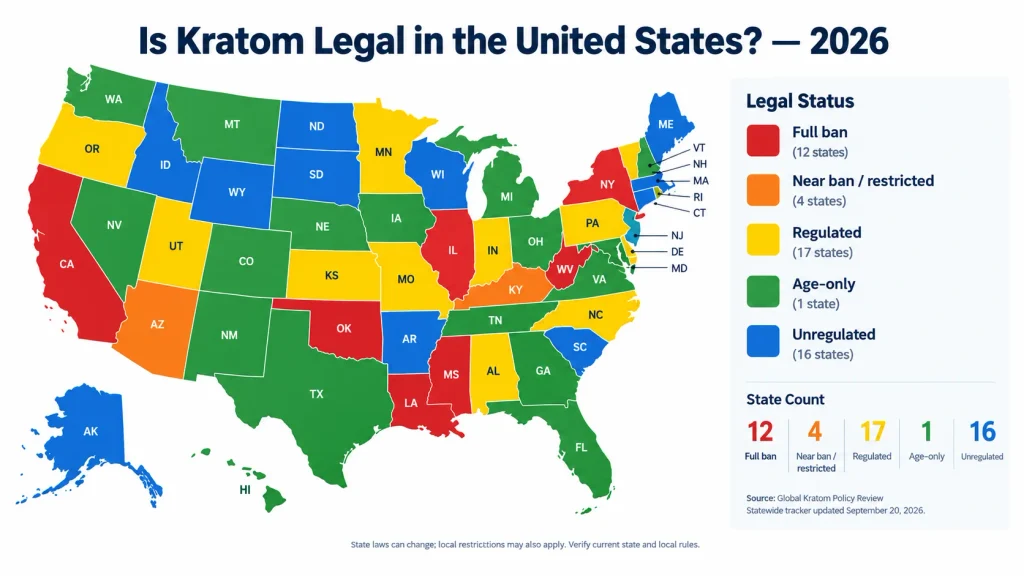
Separately, more than 20 states have adopted some version of a Kratom Consumer Protection Act (KCPA). A regulatory framework rather than a ban, typically including a minimum purchase age of 21, mandatory batch testing, labeling requirements limiting 7-OH content to naturally occurring levels. And restrictions on unapproved health claims. States that have adopted KCPA-style laws include Utah, Georgia, Arizona, Nevada, Oregon, Colorado, Florida, Oklahoma, Maryland, Kentucky, Mississippi, South Carolina, West Virginia, and Missouri, among others.
Rhode Island is a notable example. The state banned kratom outright starting in 2017, then replaced that ban with a regulated KCPA framework, effective April 1, 2026.
Kratom Outside the United States
Kratom’s legal status varies significantly by country and is not consistent internationally. Some countries, including its native range in parts of Southeast Asia, have historically restricted or banned kratom domestically. Even though it grows there naturally, Indonesia, a major global kratom exporter, introduced new export restrictions in October 2024 affecting global supply. Other countries regulate it more loosely or leave it unaddressed by specific legislation. Given how quickly this landscape shifts, readers outside the US should verify current law with their own national drug regulatory authority rather than relying on any general summary.
What Does Current Research Say?
Kratom research spans several different types of evidence, and they are not interchangeable in strength.
Laboratory and animal research has clarified some of kratom’s receptor pharmacology. Including mitragynine’s partial mu-opioid agonism and its apparent ceiling effect on respiratory depression in animal models. This is useful for understanding mechanism, but does not establish human safety or efficacy on its own.
Case reports and toxicology surveillance, including US poison control center data, have documented adverse events associated with kratom use. Useful for identifying safety signals but not designed to establish how common a given risk is across all users.
Observational surveys capture self-reported use patterns and effects but cannot establish cause and effect the way a controlled trial can.
Clinical trials in humans remain very limited for kratom specifically. The most significant recent development is NIH’s June 2026 announcement that it cleared an Investigational New Drug (IND) application for a purified mitragynine formulation. Developed with the University of Florida, to begin formal clinical study as a potential opioid use disorder treatment. This marks a meaningful step toward rigorous human research. But it is the start of a formal trial process, not a conclusion.
NCCIH own summary is direct on this point. Research on kratom is in its early stages, and much remains to be learned about its short- and long-term effects, safety, and whether it may have legitimate therapeutic uses.
Kratom and Pain
Pain relief is the most frequently cited reason people report using kratom. And it has a plausible pharmacological basis given mitragynine and 7-OH’s activity at opioid receptors.
However, self-treatment of pain with an unregulated, inconsistently dosed product carries real risk, particularly for anyone with a condition that warrants proper medical evaluation. Chronic pain in particular can have many underlying causes that benefit from diagnosis and a structured treatment plan. Kratom is not a substitute for that evaluation, and no kratom product is FDA-approved to treat pain.
Kratom and Opioid Withdrawal
Some people report using kratom to ease symptoms during opioid withdrawal. And researchers have taken this use case seriously enough to pursue formal clinical trials, including NIH’s 2026 mitragynine study.
At the same time, using kratom, itself a substance with dependence potential, to manage withdrawal from another substance carries an acknowledged risk. Some people who start using kratom for this purpose develop kratom dependence in turn. This doesn’t mean the underlying research question isn’t worth pursuing. It means kratom is not currently an approved or clinically established opioid use disorder treatment, and people experiencing opioid withdrawal are better served working with a healthcare provider on evidence-based treatment options. Including FDA-approved medications for opioid use disorder.
Kratom and Mental Health
People report using kratom for anxiety, low mood, and stress. But these uses rest on anecdotal and survey data rather than controlled clinical trials specifically evaluating kratom for mental health conditions.
ToperNews article does not diagnose readers or suggest kratom as a substitute for professional mental health care. Anyone experiencing ongoing anxiety, depression, or mood symptoms is better served consulting a licensed mental health professional, who can evaluate evidence-based treatment options.
Special Populations: Who Should Be Cautious
Certain groups have particular reasons to discuss kratom with a healthcare professional before considering use, based on general pharmacological risk principles rather than kratom-specific clinical trial data in each population:
Pregnant or breastfeeding individuals, given opioid-receptor activity and the lack of safety data in pregnancy. Teenagers, given both developmental considerations and legal purchase-age restrictions in many states. Older adults, who may be more sensitive to sedative effects or more likely to be on multiple medications. People with liver disease, given documented questions about kratom’s hepatic effects. People with cardiovascular conditions, given case reports of cardiovascular effects in regular users. Anyone taking prescription medications, due to potential interactions. People with a personal history of substance use disorder, given kratom’s own dependence potential.
This is general safety context, not individualized medical advice. A healthcare professional can evaluate a person’s specific health history.
Kratom Combined With Alcohol or Other Substances
Combining kratom with alcohol, benzodiazepines, prescription opioids, or other sedating substances raises particular concern. Since overlapping central nervous system depressant effects are not well studied in combination and may compound risk in ways not predictable from either substance alone.
Combining kratom with stimulants or other psychoactive substances similarly introduces interactions that haven’t been systematically studied. This article does not provide guidance on combining substances to achieve or intensify any effect.
Kratom Overdose: Warning Signs and When to Seek Help
Serious symptoms that warrant immediate emergency medical attention include difficulty breathing or unusually slow breathing, loss of consciousness or extreme drowsiness. That’s hard to rouse from seizures, chest pain, or signs of severe allergic reaction.
Polysubstance use, combining kratom with alcohol, opioids, or sedatives, significantly complicates these situations and increases risk. Which is part of why the FDA notes that many kratom-associated deaths involved other substances as well.
If you or someone else shows these symptoms after using kratom, call 911 or go to an emergency room immediately. Poison Control (1-800-222-1222) is also available for guidance in the US for suspected poisoning or concerning exposure. Including situations that aren’t yet a clear emergency but warrant expert input.
ToperNews does not provide dosage thresholds or guidance framed as a “safe” amount. Since individual risk varies too much for a general figure to be meaningful or safe to publish.
Common Kratom Myths
“Kratom is completely natural, so it’s completely safe.” Natural origin doesn’t equal safety. Many natural plant compounds, including some opioids, carry real risk. Kratom’s own FDA-documented risks include liver toxicity, seizures, and substance use disorder.
“Kratom is FDA-approved.” It is not approved as a drug, dietary supplement, or food additive.
“Kratom is never addictive.” The FDA lists substance use disorder as a documented risk associated with kratom use.
“Kratom is the same as a prescription opioid.” Mitragynine’s partial, ceiling-limited agonism at the mu-opioid receptor differs pharmacologically from full opioid agonists like morphine or oxycodone. This distinction does not mean kratom is risk-free.
“Different colored strains reliably produce different effects.” Independent evidence supporting consistent color-based effect categories across brands is limited; alkaloid content depends more on growing and processing conditions than marketing labels.
“Kratom is legal everywhere in the US.” It is banned outright in several states and regulated under KCPA-style frameworks in many others.
Consumer Safety Checklist
Before using any kratom product, consider whether the following information is actually available and verifiable:
Is the product clearly labeled with ingredients and alkaloid content? Is there a third-party certificate of analysis (COA) available? Has the product been tested for heavy metals and microbial contamination? Is the concentration of mitragynine and 7-OH clearly stated? Does the seller avoid making specific medical or therapeutic claims? Is the product legal in your specific state? Does the packaging disclose whether the product is natural leaf or a concentrated extract?
This checklist is intended to help evaluate information availability and transparency, not to recommend using kratom or any specific product.
Frequently Asked Questions
What is kratom?
Kratom is the common name for Mitragyna speciosa. A tree native to Southeast Asia whose leaves contain compounds, primarily mitragynine and 7-hydroxymitragynine, that interact with opioid receptors in the brain.
What does kratom do?
Users report both stimulant-like effects (energy, alertness) and opioid-like effects (relaxation, pain relief), according to NCCIH. Effects vary by dose, individual, and product concentration.
Is kratom an opioid?
Kratom itself is a plant, not a classical opioid drug, but its key alkaloids act on the same opioid receptors that opioid drugs act on, producing some similar effects through a different pharmacological profile (partial rather than full agonism).
Is kratom addictive?
It can produce dependence with regular use, and the FDA lists substance use disorder as a documented risk. Severity varies by individual and usage pattern.
Can kratom cause withdrawal?
Yes. Case reports describe withdrawal symptoms including irritability, muscle aches, insomnia, and low mood after stopping regular use, generally described as less severe than full opioid withdrawal, though this varies.
Is kratom legal in the US?
Natural kratom leaf is not federally scheduled, but it is banned in several states and regulated under Kratom Consumer Protection Act frameworks in many others. Legal status varies by state and can change; verify current law locally.
Is kratom FDA-approved?
No. There are no FDA-approved drug products containing kratom, and the FDA has determined it cannot be lawfully marketed as a dietary supplement or food additive.
What are the side effects of kratom?
Commonly reported effects include nausea, vomiting, constipation, dizziness, drowsiness, dry mouth, sweating, and changes in heart rate.
Can kratom interact with medications?
Yes, potentially, particularly with other central nervous system depressants and medications processed by the same liver enzyme pathways. Consult a healthcare professional or pharmacist before combining kratom with any prescription medication.
Can kratom cause liver problems?
Some research has raised questions about liver toxicity at higher doses, though disentangling kratom’s specific role from other factors like alcohol or acetaminophen use remains an active research question.
Can kratom cause an overdose?
Serious adverse events and deaths have been associated with kratom, according to the FDA, though most documented deaths involved kratom combined with other substances, making kratom’s specific contribution often unclear.
Is kratom safe?
There’s no simple yes-or-no answer. The FDA actively warns against kratom use due to documented risks including liver toxicity, seizures, and substance use disorder, while acknowledging that in many serious cases, other substances were also involved.
What are kratom strains?
Vendor-assigned color categories (red, green, white) based on leaf vein color at harvest, commonly marketed as predicting different effects, though independent evidence for consistent, brand-spanning effect differences by color is limited.
What is mitragynine?
Kratom’s primary alkaloid, a partial agonist at the mu-opioid receptor believed to underlie much of kratom’s characteristic effects.
What is 7-hydroxymitragynine?
A kratom alkaloid, present in small natural amounts in raw leaf but found in much higher concentrations in some manufactured extract products, and a current focus of federal scheduling efforts targeting concentrated forms specifically.
What is kratom powder?
Dried, ground kratom leaf, the most common and traditional commercial form.
What are kratom extracts?
Processed kratom products concentrated to contain higher alkaloid levels than raw leaf, generally carrying a higher potency and risk profile than powder or capsules.
Why do people use kratom?
Commonly reported reasons include pain management, energy, mood, and managing opioid withdrawal symptoms, though clinical evidence for most of these uses remains limited.
What does research say about kratom?
Research is still in an early stage overall, per NCCIH, though a 2026 NIH-cleared clinical trial of purified mitragynine for opioid use disorder represents a significant step toward more rigorous human research.
Can you become dependent on kratom?
Yes, regular use can lead to physical dependence, and stopping can produce withdrawal symptoms.
What should you know before using kratom?
That it’s not FDA-approved for any use, that its legal status depends on your state, that product quality and labeling aren’t federally regulated, and that it carries real documented risks, particularly around dependence and combining it with other substances.