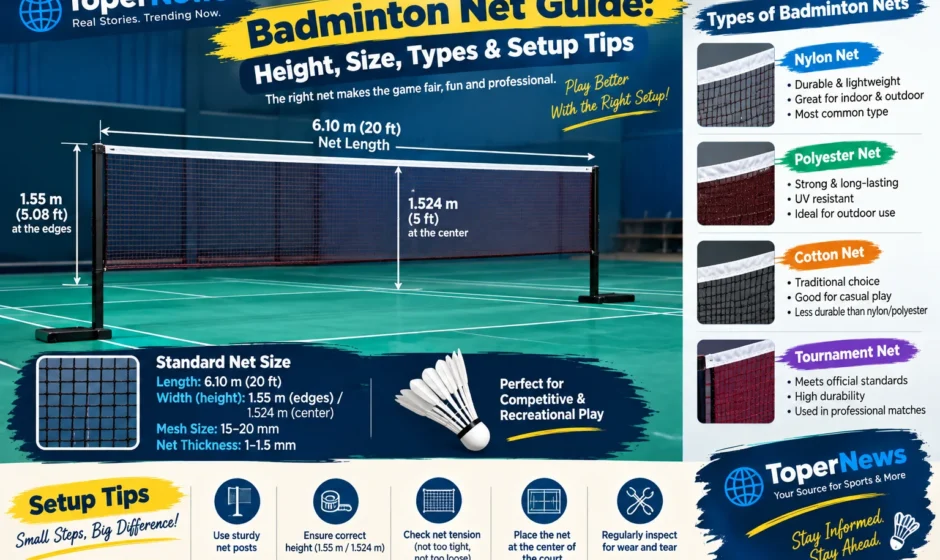

A badminton net looks simple, yet it shapes every rally in the game. Players judge distance, height, and timing against it on every shot. Get the net wrong, and the whole game feels off.
This guide covers every detail about a badminton net. You will learn the official dimensions, the materials, the types, and the setup steps. Whether you play casually or compete, this guide answers your questions.
What Is a Badminton Net?
A badminton net divides the court into two equal halves. It stands at the center of the court, supported by two posts on each side. Players hit the shuttlecock over it during every point.
The net looks similar to a volleyball or tennis net, but it holds different specs. Badminton nets sit lower and carry lighter materials. That design suits the fast, light nature of the shuttlecock.
Official Badminton Net Dimensions
The Badminton World Federation, or BWF, sets exact rules for net dimensions. Every official match must follow these numbers.
| Measurement | Metric | Imperial |
| Height at the posts | 1.55 m | 5 ft 1 in |
| Height at the center | 1.524 m | 5 ft |
| Width | 6.1 m | 20 ft |
| Depth | 760 mm | 2.5 ft |
| Mesh size | 15–20 mm | 0.6–0.8 in |
Why the Net Height Changes at the Center?
Notice the height difference between the posts and the center. The net dips slightly in the middle by design. Gravity pulls the mesh down between the two support points.
BWF rules account for this dip on purpose. Officials measure both points before every match. A net that sags too much or sits too tight breaks the rules.
How High Is a Badminton Net?
A badminton net stands 1.55 meters tall at the posts. It measures 1.524 meters at the center of the court. That difference equals about one inch.
This height applies to every format of the game. Singles and doubles matches use the same net height. Only the court width changes between those two formats.
How Tall Is a Badminton Net?
Net height and net tallness mean the same measurement here. A badminton net reaches 5 feet 1 inch at each post. It drops to exactly 5 feet at the center point.
Players often confuse net height with net post height. The posts themselves stand at 1.55 meters. The net attaches to the posts at that same height.
How Wide Is a Badminton Net?
A regulation badminton net spans 6.1 meters across. That distance equals 20 feet in imperial measurement. This width matches the doubles court width exactly.
Net posts sit on the doubles sidelines in every match. Singles courts use narrower boundaries than doubles courts. The net width, however, never shrinks for singles play.
How Big Is a Badminton Net?
Net size includes three factors: height, width, and depth. The BWF badminton net measures 1.524–1.55 meters tall. It spans 6.1 meters wide and hangs 760 mm deep.
Manufacturers also follow strict rules on mesh size. Holes in the net must measure between 15 and 20 mm. Smaller holes trap the shuttlecock; larger holes let it slip through.
Parts of a Badminton Net
A complete badminton net system includes several components. Each part plays a specific role in setup and performance.
- Net mesh: The woven fabric that spans the court width.
- Top tape: A white band along the top edge of the net.
- Side tape: Reinforced edges that attach to the posts.
- Net cord: A cord or wire inside the top tape for tension.
- Posts: Vertical supports that hold the net upright.
- Base or ground anchors: Weights or stakes that stabilize the posts.
- Center strap: A strap that pulls the net down to the correct center height.
Types of Badminton Nets
Different playing environments call for different net styles. Here are the main types you will find.
Standard Competition Nets
These nets follow exact BWF specifications. Tournaments and clubs use this type for official matches. They feature durable mesh, reinforced tape, and metal cord support.
Recreational Nets
Recreational nets relax the strict tolerances of competition gear. Families and casual players use them in backyards and parks. They cost less and often pack into a lightweight bag.
Portable Badminton Nets
Portable sets include collapsible posts and a carry bag. Players take them to parks, beaches, or driveways. Setup usually takes only a few minutes.
Freestanding Nets
Freestanding nets use weighted bases instead of ground stakes. They work well on hard surfaces like driveways or gym floors. No drilling or staking becomes necessary.
Combo Nets
Combo sets serve multiple sports, such as badminton, volleyball, and tennis. Adjustable height settings switch between each game. Families who play several sports often prefer this option.
Badminton Net Materials
Manufacturers build nets from a few common materials. Each material offers different strength and weather resistance.
- Nylon mesh: Lightweight, common, and budget-friendly for most players.
- Polyester mesh: Slightly heavier and more resistant to stretching.
- Braided nylon: Adds extra durability for frequent outdoor use.
- PVC-coated tape: Protects the top and side edges from wear.
- Steel cable core: Runs through the top tape on premium nets for tension control.
Weather resistance matters for outdoor players. UV-treated mesh resists fading and cracking under sun exposure. Waterproof coatings help nets survive rain and humidity.
Net Posts: The Support System
Posts hold the net at the correct height throughout a match. BWF rules require posts to stand 1.55 meters tall. They must sit exactly on the doubles sidelines, even during singles play.
Post Materials
- Aluminum posts stay light and resist rust.
- Steel posts offer more stability but weigh more.
- Fiberglass posts flex slightly and suit recreational setups.
Post Stability Features
- Adjustable height clamps fine-tune net tension.
- Weighted bases stop posts from tipping over.
- Ground sleeves anchor posts into permanent court installations.
- Guy wires add extra support for outdoor, windy conditions.
How to Set Up a Badminton Net
Setting up a badminton net correctly takes only a few steps. Follow this process for a safe, regulation-ready net.
- Choose a flat, open area. Measure at least 6.1 meters of clear width.
- Position the posts. Place them exactly 6.1 meters apart, on the sidelines.
- Secure the base. Use ground stakes outdoors or weighted bases indoors.
- Attach the net to both posts. Hook the top tape onto the post clips.
- Raise the net gradually. Pull it up evenly on both sides at once.
- Adjust the height. Set 1.55 meters at the posts using a measuring tape.
- Attach the center strap. Pull the center down to exactly 1.524 meters.
- Check the tension. The mesh should stay tight without excess sag.
- Inspect for damage. Look for tears, loose tape, or bent posts before play.
Common Setup Mistakes
- Skipping the center strap, which leaves the net too high in the middle.
- Placing posts too close together, which loosens the mesh.
- Ignoring wind conditions, which can pull outdoor nets off balance.
- Forgetting to double-check measurements before a match starts.
Badminton Net Maintenance Tips
A well-maintained net lasts far longer than a neglected one. Follow these simple habits to protect your investment.
- Store the net indoors between uses, away from direct sunlight.
- Dry the mesh fully before folding it away after rain.
- Check for loose stitching or fraying edges every few weeks.
- Replace worn center straps before they snap during play.
- Clean posts and bases to prevent rust buildup over time.
Indoor vs. Outdoor Badminton Nets
Both play create different demands on net equipment.
Indoor nets face steady conditions without wind or rain. Lighter mesh and simpler posts work fine indoors. Gym floors also allow ground sleeves for permanent setups.
Outdoor nets face wind, sun, and moisture on a regular basis. Heavier, UV-treated mesh performs better outside. Weighted bases or stakes keep the posts steady in open air.
Choosing the Right Badminton Net for You
Your choice depends on how often you play and where. Consider these factors before you buy.
- Skill level: Competitive players need BWF-certified specs.
- Location: Outdoor players need weather-resistant materials.
- Portability: Frequent travelers benefit from collapsible, bagged sets.
- Budget: Recreational nets cost less than tournament-grade equipment.
- Surface type: Hard surfaces favor freestanding bases over stakes.
Frequently Asked Questions
How high is a badminton net?
A badminton net stands 1.55 meters tall at the posts. It drops to 1.524 meters at the center of the court.
How tall is a badminton net?
The net reaches 5 feet 1 inch at each post. It measures 5 feet exactly at the center point.
How wide is a badminton net?
A regulation badminton net spans 6.1 meters, or 20 feet. This width matches the doubles court boundary.
How to set up a badminton net?
Place the posts 6.1 meters apart on the sidelines. Attach the net, raise it evenly, and set the height to 1.55 meters at the posts. Then pull the center strap down to 1.524 meters.
How big is a badminton net?
A badminton net measures 1.524 to 1.55 meters tall, 6.1 meters wide, and 760 mm deep. Mesh holes measure between 15 and 20 mm.
What material makes the best badminton net?
Braided nylon and polyester mesh offer strong durability. UV-treated versions work best for outdoor courts.
Does the net height change for singles and doubles?
No. Both formats use the same net height throughout the match. Only the court width changes between singles and doubles.
Why does a badminton net sag in the middle?
The net sags slightly due to gravity between the two posts. BWF rules account for this dip in the official height measurement.
Can I use a badminton net outdoors?
Yes. Choose a net with UV-treated, weather-resistant mesh. Add weighted bases or stakes to keep the posts stable in wind.
How often should I replace a badminton net?
Replace the net once you notice fraying, tears, or a stretched-out mesh. Regular players often replace nets once a year.
Final Thoughts
A badminton net does more than split the court in half. It sets the standard for fair, consistent play at every level. Get the height, width, and setup right, and your game stays fair.
Whether you buy a competition-grade net or a backyard set, check the specs first. Match the BWF standards for serious play, or relax them for casual fun. Either way, a properly set net makes every match more enjoyable.