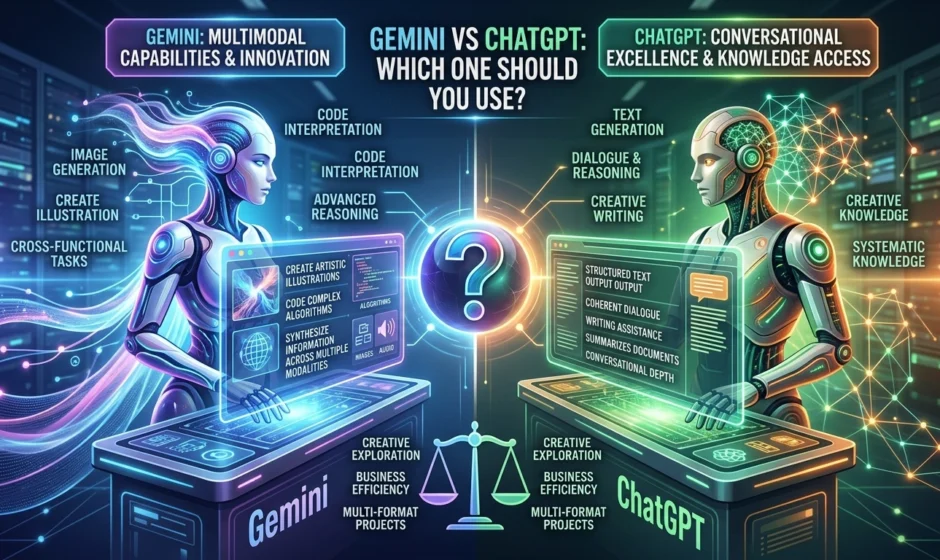

Gemini and ChatGPT have become the two most visible AI assistants in the world, and both companies keep shipping new models fast enough that any comparison risks going stale within weeks. Still, the core question hasn’t changed: which one should you actually be using?
The honest answer is that neither wins outright — they’ve specialized in different directions. This guide breaks down where each one leads, where they’re evenly matched, and which is the better fit depending on what you actually need an AI assistant for. If you’re new to how modern AI assistants work under the hood, our explainer on agentic AI covers the broader shift toward AI that acts on tasks rather than just answering questions — a trend both platforms are racing to build into their products.
Current Models and Pricing
Both companies have shipped multiple model generations this year, so it’s worth being clear about what “ChatGPT” and “Gemini” actually mean right now:
- ChatGPT runs on the GPT-5.6 family, split into three tiers: Sol (flagship), Terra (balanced), and Luna (fast and cheapest).
- Gemini defaults to Gemini 3.6 Flash for free users, with Gemini 3.1 Pro as the paid flagship reasoning model. A Gemini 3.5 Pro has been anticipated but was not yet released as of this writing.
| Plan Tier | ChatGPT | Gemini |
| Free | GPT-5.6 (limited) | Gemini 3.6 Flash, limited Pro queries |
| Entry paid | Go — ~$8/mo | AI Plus — ~$4.99/mo |
| Mid paid | Plus — $20/mo | AI Pro — ~$19.99/mo |
| Premium | Pro — $100/mo, Pro Max — $200/mo | AI Ultra — from ~$99.99/mo |
At the popular $20/month tier, pricing between ChatGPT Plus and Gemini AI Pro is nearly identical — so the decision comes down to features and ecosystem fit rather than cost.
Where ChatGPT Leads?
- Coding and agentic tasks. ChatGPT’s GPT-5.6 Sol currently posts the strongest results on agentic coding benchmarks, and its Agent Mode and computer-use capabilities are more mature for multi-step, tool-using tasks.
- Structured reasoning. ChatGPT tends to produce more layered, step-by-step chain-of-thought output, which shows up in tasks like structured research, technical explanations, and complex problem-solving.
- Ecosystem breadth. ChatGPT connects to a wider range of third-party business apps and tools, making it a more flexible standalone assistant regardless of what software stack you already use.
- Market position. ChatGPT still holds roughly two-thirds of the AI chatbot market, reflecting a three-year head start and broad brand recognition.
Where Gemini Leads?
- Native multimodal understanding. Gemini was built from the ground up to handle text, images, audio, and video as one unified system, rather than adding modalities on top of a text-first model. It’s currently the only frontier consumer assistant with native video understanding — you can upload a lengthy video and ask about specific scenes or spoken dialogue directly.
- Google ecosystem integration. Gemini connects directly to Gmail, Drive, Docs, Sheets, Slides, Maps, Search, and Android, making it the more natural choice for anyone whose work already lives inside Google Workspace.
- Real-time, web-grounded research. Because Gemini leans heavily on Google’s search index, it tends to hallucinate less on time-sensitive, fast-moving topics, and its Deep Research feature can pull current information with reliable sourcing.
- Lower API costs. For developers, Gemini’s API pricing runs significantly cheaper per token than ChatGPT’s, which matters at scale.
Head-to-Head Comparison Table
| Category | ChatGPT | Gemini |
| Best for | Coding, agentic workflows, general-purpose writing | Google Workspace users, research, multimodal tasks |
| Reasoning style | Deep, structured chain-of-thought | Faster, blends multimodal and real-time context |
| Video understanding | Limited (no native video input) | Native video upload and analysis |
| Ecosystem | Broad third-party app integrations | Deep native Google integration |
| Memory | Persistent memory with granular user controls | “Personal Intelligence” pulling from Gmail, Photos, Search (opt-in) |
| API cost | Higher per token | Roughly 50-70% cheaper per token |
| Market share | ~64% of AI chatbot market | Fastest-growing, ~20%+ share |
Memory and Personalization
Both platforms have leaned into long-term memory, but they approach it differently. ChatGPT’s memory learns from your conversations over time — preferences, writing style, and recurring topics — and applies that context across sessions, with the ability to view, delete, or wipe specific memories. Gemini’s “Personal Intelligence” feature goes further by pulling context directly from a user’s connected Google data (Gmail, Photos, Search history) after opt-in, which lets it answer more personal, context-dependent questions but also means sharing more data with the platform.
Image and Video Generation
Both platforms produce strong AI-generated images, with a few practical differences: ChatGPT generates a single image per prompt, while Gemini produces a set of four and gives free users a more generous daily generation quota. Video is a clearer split — Gemini’s Veo model consistently ranks at the top of video generation leaderboards and generates native audio alongside video, while ChatGPT discontinued its own video generation tool. If video generation specifically matters to your workflow, this is one of the more decisive differences between the two platforms this year.
Which One Should You Actually Use?
- Choose ChatGPT if: you want the strongest general-purpose AI agent, need advanced coding or agentic workflows, or you’re not particularly tied to the Google ecosystem.
- Choose Gemini if: your work already lives in Google Workspace or Android, you regularly work with video/audio files or very large documents, or you want lower ongoing API costs for development work.
- Consider using both: many power users now run a two-model workflow — Gemini for research, multimodal analysis, and Google-native tasks, and ChatGPT for daily assistance, writing, and tool-heavy automation. Since both offer usable free tiers, testing your own real prompts on each before committing to a paid plan is a reasonable way to decide.
The Bottom Line
There’s no longer a single “better” AI assistant in 2026 — ChatGPT and Gemini have diverged enough that the right choice depends entirely on your workflow. If you’re deep in Google’s ecosystem or working with video and large documents, Gemini’s integration and multimodal strength are hard to beat. If you want the most capable general-purpose agent for coding and complex tool use, ChatGPT currently holds the edge. For many people, the most practical answer is simply using both for what each does best.
Frequently Asked Questions
Is Gemini or ChatGPT better?
Neither is objectively better — they specialize differently. ChatGPT leads in coding, agentic workflows, and structured reasoning, while Gemini leads in native multimodal understanding (especially video), Google Workspace integration, and real-time research.
Is Gemini or ChatGPT cheaper?
At the popular $20/month tier, pricing is nearly identical between ChatGPT Plus and Gemini AI Pro. Gemini’s API is meaningfully cheaper per token for developers, and its free tier tends to offer more generous usage limits for casual users.
Which AI is better for coding?
ChatGPT’s GPT-5.6 currently leads on agentic coding benchmarks and complex, multi-step coding tasks, though Gemini remains competitive, particularly for large-codebase context thanks to its long context window.
Can Gemini understand video, and can ChatGPT?
Gemini has native video understanding — you can upload a video and ask questions about specific scenes or dialogue. ChatGPT does not currently process uploaded video natively.
Should I use both ChatGPT and Gemini?
Many users do, since the two platforms play to different strengths. A common approach is using Gemini for research, multimodal tasks, and Google-native work, and ChatGPT for general assistance, writing, and coding-heavy tasks.