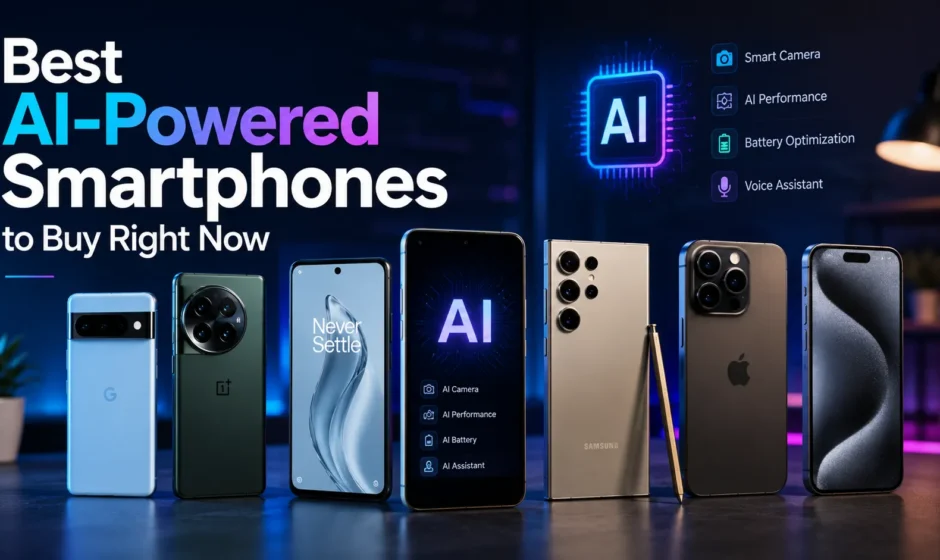

Every flagship phone released claims to be an “AI phone,” but the label has become so overused it barely means anything on its own. The real differences show up in the details: how fast a phone’s neural processing unit (NPU) actually runs AI models on-device, how deeply an AI assistant is woven into daily tasks like messaging and photos, and whether those features solve real problems or just look good in a keynote demo.
This guide compares eight of the best AI-powered smartphones across price points, so you can find one whose AI features actually fit how you use your phone, not just the one with the longest spec sheet.
How We Compared These Phones
- NPU performance: how many AI models the chip can run on-device, and how fast
- Assistant depth: whether the AI assistant handles simple commands or complex, cross-app tasks
- Camera AI: computational photography, generative editing, and video enhancement
- Ecosystem integration: how well AI features connect across apps, devices, and services
- Value: whether the AI experience justifies the price relative to alternatives
AI-SmartPhone Comparison
| Phone | Best For | Starting Price | NPU / Chipset | Standout AI Feature |
| Samsung Galaxy S26 Ultra | Broadest AI feature set | ~$1,299 | Snapdragon 8 Elite Gen 5 | Live call translation, generative photo editing |
| Google Pixel 10 Pro | Deepest assistant integration | ~$999 | Tensor G5 | Magic Cue proactive suggestions, Gemini integration |
| Apple iPhone 17 Pro Max | Privacy-first ecosystem integration | ~$1,199 | A19 Pro (38 TOPS) | On-device Apple Intelligence, live call translation |
| Xiaomi 17 Ultra | Best camera hardware | ~$1,099 | Snapdragon 8 Elite Gen 5 | 1-inch sensor with AI-assisted variable aperture |
| OnePlus 13 | Best value flagship | ~$799 | Snapdragon 8 Elite | Flagship-level NPU at a lower price |
| Motorola Razr Ultra | Unique foldable + AI assistant | ~$999 | Snapdragon 8 Elite | Dedicated AI Key, built-in Perplexity |
| vivo X200 Pro | Photography and content creation | ~$899 | Dimensity/Snapdragon (region-dependent) | AI-enhanced video and portrait modes |
| Samsung Galaxy A16 5G | Best budget AI phone | ~$199 | Mid-range NPU | AI-enhanced camera scene optimization |
The 8 Best AI-Powered Smartphones
1. Samsung Galaxy S26 Ultra | Best Overall AI Feature Set
The Galaxy S26 Ultra currently has the broadest AI feature set of any phone on the market, combining live call translation across more than a dozen languages, generative image editing, and on-device document processing through its Snapdragon 8 Elite Gen 5 chip. Its “Now Nudge” feature works proactively in the background — for example, prepping and suggesting a photo album to send before you’ve even opened your gallery, if a friend has texted asking for pictures. It pairs Google’s Gemini with Samsung’s own Galaxy AI layer, giving it both assistant depth and Samsung-specific tools.
Best for: Buyers who want the widest range of AI features in one device, regardless of ecosystem. Trade-off: Premium pricing, and the sheer number of features can feel like more than most people will regularly use.
2. Google Pixel 10 Pro | Best AI Assistant Integration
Google builds the Pixel around Gemini, and it shows — the assistant is woven into nearly everything, from “Circle to Search” (drawing a circle around anything on-screen to look it up instantly) to Magic Cue, which surfaces relevant information from your email or messages before you ask for it. Since Google builds both the hardware (Tensor G5 chip) and the AI models running on it, the Pixel offers arguably the most cohesive AI experience of any phone, with on-device processing that keeps most tasks private. If you’re deciding between AI ecosystems more broadly, our Gemini vs ChatGPT comparison covers how Gemini stacks up against OpenAI’s assistant beyond just phones.
Best for: Anyone who wants the most proactive, deeply integrated AI assistant experience. Trade-off: Some of the most advanced Gemini features are still gradually rolling out and aren’t uniformly available everywhere at launch.
3. Apple iPhone 17 Pro Max | Best for Privacy-First Ecosystem Integration
Apple Intelligence takes a more restrained approach than Samsung or Google, focusing on privacy and tight integration across Apple’s own devices rather than the widest possible feature list. Live translation during calls and video chats, message rewriting, and photo library search using natural, plain-language sentences are all handled predominantly on-device. For questions Siri can’t confidently answer itself, it now hands off to ChatGPT — reflecting a broader industry trend, similar to how agentic AI is increasingly handling handoffs between systems to complete a task.
Best for: Apple ecosystem users who prioritize privacy and tight cross-device integration over raw feature count. Trade-off: Fewer standalone AI features than Samsung’s Galaxy AI, since Apple’s approach favors depth over breadth.
4. Xiaomi 17 Ultra | Best Camera Hardware
Xiaomi’s flagship pairs a 1-inch main sensor with Leica optics and a variable aperture (f/1.4 to f/4.0) — technology historically reserved for dedicated cameras. The larger sensor captures significantly more raw light and detail, giving the phone’s AI image processing engine richer data to work with, which shows up clearly in low-light and portrait photography.
Best for: Photography enthusiasts who want the strongest camera hardware paired with AI processing. Trade-off: More limited availability outside Asia and Europe compared to Samsung, Apple, or Google.
5. OnePlus 13 | Best Value Flagship
OnePlus continues to deliver flagship-level NPU performance — identical Snapdragon 8 Elite silicon to phones costing hundreds of dollars more — at a noticeably lower price. Rather than building extensive platform-specific AI features, OnePlus leans on Google’s underlying AI improvements benefiting the device broadly, trading some brand-specific polish for simplicity and consistent performance.
Best for: Buyers who want genuine flagship AI performance without flagship pricing. Trade-off: Fewer proprietary AI features compared to Samsung or Google’s more customized software layers.
6. Motorola Razr Ultra | Best AI-Enabled Foldable
The Razr Ultra stands out with a dedicated AI Key and a partnership that pre-installs Perplexity directly on the device — the first such smartphone partnership of its kind. Combined with its foldable form factor, it offers a distinct take on how AI assistants can be made more immediately accessible than digging through an app.
Best for: Buyers who want a foldable phone with a genuinely differentiated AI assistant setup. Trade-off: Foldable form factors still carry durability trade-offs and a price premium compared to traditional flagships.
7. vivo X200 Pro | Best for Photography and Content Creation
vivo’s flagship leans into AI-enhanced video and portrait modes, making it a strong pick for creators who shoot a lot of content directly from their phone. Its computational photography pipeline is tuned specifically for consistent skin tones and stabilization in handheld video, complementing dedicated tools covered in our best AI video editors roundup for anyone editing that footage afterward.
Best for: Content creators who shoot and want strong in-camera AI processing before editing. Trade-off: Less globally available than Samsung, Apple, or Google devices, depending on region.
8. Samsung Galaxy A16 5G | Best Budget AI Phone
You don’t need flagship pricing to get genuinely useful AI features. The Galaxy A16 5G’s 50MP camera uses AI-enhanced scene optimization to sharpen detail and balance lighting automatically, proving that meaningful on-device AI has trickled down to budget devices, not just $1,000+ flagships.
Best for: Budget-conscious buyers who still want real AI camera and performance benefits. Trade-off: Noticeably less powerful NPU and fewer advanced assistant features than flagship models.
How to Choose the Right AI Smartphone?
- If you want the most features overall: Samsung Galaxy S26 Ultra offers the broadest AI toolkit available today.
- If assistant quality matters most: Google Pixel 10 Pro’s Gemini integration is the deepest and most proactive.
- If you’re already in Apple’s ecosystem: iPhone 17 Pro Max prioritizes privacy and cross-device consistency over raw feature count.
- If photography is the priority: Xiaomi 17 Ultra’s camera hardware currently leads the category.
- If budget matters most: OnePlus 13 delivers flagship AI performance for meaningfully less, and the Galaxy A16 5G proves even entry-level phones now benefit from real on-device AI.
The Bottom Line
The best AI smartphone isn’t necessarily the one with the most features advertised at launch — it’s the one whose AI capabilities solve problems you’ll actually encounter day to day. Most buyers use only a handful of the AI features advertised during a launch event, so it’s worth thinking about which specific tasks (translation, photo editing, proactive suggestions, camera quality) matter most to you before choosing based on spec sheets alone.
Frequently Asked Questions
What makes a smartphone an “AI phone”?
A genuine AI phone has a dedicated Neural Processing Unit (NPU) that runs AI tasks like photo enhancement, transcription, and assistant features directly on the device, rather than a phone that simply has a chatbot app installed or basic camera filters.
Which phone has the best AI assistant?
The Google Pixel 10 Pro is widely considered to have the deepest AI assistant integration, thanks to Gemini’s proactive features like Magic Cue and Circle to Search working natively across the operating system.
Is Samsung or Google better for AI features?
Samsung generally offers a broader range of individual AI features through Galaxy AI, including live call translation and generative editing, while Google’s Gemini integration is considered more precise and proactive for everyday task completion. The better choice depends on whether you value feature breadth or assistant depth.
Do budget phones have real AI features, or is it just marketing?
Budget phones do include genuine AI capabilities, such as AI-enhanced camera scene optimization, though they typically use less powerful NPUs and lack the advanced assistant features found on flagship devices.
Do I need a phone with a powerful NPU if I don’t use many AI features?
Not necessarily. If you rarely use translation, generative editing, or proactive assistant features, a mid-range phone will likely meet your needs. A powerful NPU matters most for users who plan to rely heavily on on-device AI processing, including tasks like running local AI models.