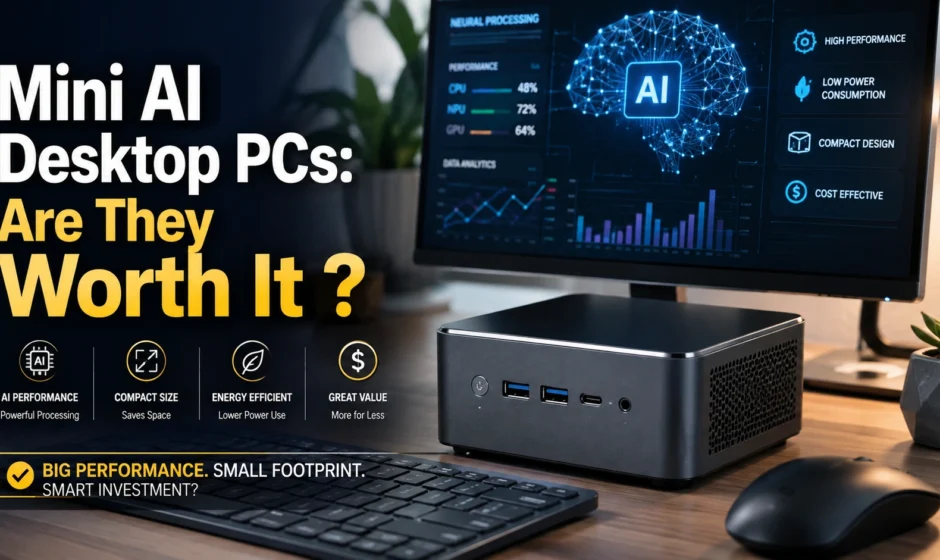

AMD’s head of client OEM said it plainly at CES: mini PCs are “really having a moment.” What used to be a niche category for home theater boxes and thin clients has turned into one of the fastest-growing corners of the PC market, largely because a new generation of chips has made it possible to run genuinely capable AI workloads — including local language models — inside a box smaller than a hardcover book.
But “mini AI PC” gets used loosely, covering everything from a $200 budget box with a basic NPU to a $2,000+ workstation that can run 70-billion-parameter models locally. This guide breaks down what these machines are actually good for, the top picks across price points, and — the question that matters most — whether one is genuinely worth buying over a laptop or traditional desktop.
What Makes a PC a “Mini AI PC”?
A mini AI PC is a compact desktop that pairs a CPU and GPU with a dedicated Neural Processing Unit (NPU), letting it run AI tasks — from Windows Copilot+ features to fully local large language models — without relying on the cloud. Three chip families currently define the category: AMD’s Ryzen AI line (including the high-end Ryzen AI Max+ 395, nicknamed “Strix Halo”), Intel’s Core Ultra series, and Apple’s M-series chips powering the Mac mini.
The single most important spec to actually pay attention to isn’t the NPU’s TOPS (trillion operations per second) rating — it’s memory. Local AI models need to fit entirely in RAM or VRAM to run well, so a system with more unified memory will often outperform one with a flashier NPU number on the box but not enough memory to hold a useful model.
Quick Comparison Table
Model |
Best For |
Approx. Price |
Chip |
Standout Feature |
Apple Mac mini (M4 Pro) |
Mac ecosystem users, quiet operation |
From ~$1,499 |
Apple M4 Pro |
Near-silent under AI workloads |
Minisforum AI X1 Pro |
Best overall Windows AI mini PC |
~$800-1,200 |
Ryzen AI 9 HX 370 |
Replaceable DDR5, expandable |
GMKtec EVO-X2 |
Running large local LLMs |
~$1,700-2,000+ |
Ryzen AI Max+ 395 |
Up to 128GB unified memory |
GEEKOM A9 Max |
High-power Windows productivity |
~$900-1,100 |
Ryzen AI 9 HX 370 |
80 TOPS, Copilot+ certified |
Beelink SER9 |
Budget-friendly AI mini PC |
~$600-800 |
Ryzen AI 9 |
Strong value for the price |
MINISFORUM MS-01/MS-02 |
Workstation-class expandability |
~$1,000-2,000+ |
Intel/AMD (varies) |
PCIe slot for a discrete GPU |
ASUS NUC (Core Ultra) |
Business/IT fleet standardization |
~$700-1,200 |
Intel Core Ultra |
vPro manageability, reliability |
Geekom A6 |
Budget general-purpose mini PC |
~$400-500 |
AMD Ryzen 6800H |
Affordable, ready-to-use out of the box |
Top Mini AI PCs Worth Considering
1. Apple Mac mini (M4 Pro) — Best for Mac Users and Quiet Operation
The Mac mini remains a standout for anyone in Apple’s ecosystem, offering strong efficiency and near-silent operation even under sustained AI inference — its fan rarely spins up compared to most Windows/Linux alternatives, which tend to ramp noticeably under heavy load. Apple’s MLX framework also runs meaningfully faster than generic inference tools on Apple Silicon for many local model workloads.
Best for: macOS users who want a quiet, efficient desktop that handles both everyday work and local AI tasks well. Trade-off: Less expandable than Windows mini PCs, and higher-memory configurations get expensive quickly.
2. Minisforum AI X1 Pro — Best Overall Windows AI Mini PC
Built around AMD’s Ryzen AI 9 HX 370 and Radeon 890M graphics, the AI X1 Pro balances strong CPU and AI performance with genuine flexibility — replaceable DDR5 memory, OCuLink support for an external GPU, and dual networking. That combination of performance and upgradeability is rare in this form factor.
Best for: Windows users who want strong all-around performance with room to expand later. Trade-off: Costs more than budget mini PCs, and still can’t match a full desktop tower for maximum expandability.
3. GMKtec EVO-X2 — Best for Running Large Local AI Models
For anyone serious about running large language models entirely offline, the EVO-X2’s headline feature is memory: configurations with up to 128GB of unified LPDDR5X let it run 70-billion-parameter-class models that would be completely out of reach for systems with a smaller, faster-looking NPU but limited RAM.
Best for: Developers and AI enthusiasts who want to run large models locally without cloud subscriptions. Trade-off: Higher price point, and very large models still push the limits of what any mini PC can comfortably handle.
4. GEEKOM A9 Max — Best for High-Power Windows Productivity
The GEEKOM A9 Max delivers an 80 TOPS AI performance rating, qualifying it as a Copilot+ PC, and comfortably handles demanding creative workloads — video editing in DaVinci Resolve or Premiere Pro, and heavier Photoshop work — similar to the editing tools covered in our best AI video editors guide. Broad connectivity, including dual USB4 and Wi-Fi 7, rounds out a genuinely desktop-replacement-worthy machine.
Best for: Power users who want a Mac mini alternative on Windows for both productivity and light creative work. Trade-off: A step down in expandability compared to workstation-class options like the MS-01/MS-02.
5. Beelink SER9 — Best Budget Mini AI PC
Beelink’s SER9 delivers a capable Ryzen AI chip and generous RAM at a notably lower price than most competitors, making it the value leader for anyone who wants real AI capability without workstation-level spending.
Best for: Budget-conscious buyers who still want genuine on-device AI performance. Trade-off: Less headroom for the largest local AI models compared to higher-memory options like the EVO-X2.
6. MINISFORUM MS-01 / MS-02 — Best for Workstation-Class Expandability
The MS-01 and MS-02 stand apart by including a PCIe slot that accepts a half-height discrete GPU — a rare feature in this category that matters significantly for anyone who wants real dedicated VRAM for local AI or heavier creative workloads, rather than relying on integrated graphics alone.
Best for: Users who want mini-PC size without giving up GPU expandability entirely. Trade-off: Adding a GPU increases both cost and power draw, narrowing the size and efficiency advantage that draws people to mini PCs in the first place.
7. ASUS NUC (Core Ultra series) — Best for Business and IT Fleets
Now under ASUS after Intel spun off the NUC line, these systems remain the go-to choice for businesses standardizing across a device fleet, thanks to Intel’s vPro manageability tools and a reliability track record IT departments trust.
Best for: Businesses deploying multiple identical machines with centralized management needs. Trade-off: Less exciting for AI enthusiasts specifically chasing maximum local-model performance.
8. Geekom A6 — Best Budget General-Purpose Mini PC
The A6 is a genuinely complete, ready-to-use PC at an accessible price, with 32GB of RAM and a surprisingly generous port selection for its size. It uses an older AMD chip without the newer AI-specific processing features, making it better suited to general computing than dedicated local AI work.
Best for: Buyers who mainly want a small, capable everyday PC and don’t need serious local AI performance. Trade-off: Lacks the modern NPU found in newer AI-focused mini PCs.
Are Mini AI PCs Actually Worth It?
For most everyday users — browsing, office work, streaming, video calls — a mini PC is absolutely worth considering over a traditional tower or even a laptop if the machine stays on a desk. They’re quieter, use less power, take up far less space, and modern chips now deliver performance that rivals full-sized desktops for the vast majority of tasks.
For the specific promise of running local AI models: it depends heavily on what you’re trying to run. A $300-500 mini PC with 32GB of RAM handles smaller 7-13B parameter models at conversational speeds, with no subscription costs, no per-query fees, and no data leaving your network — a genuinely compelling case for privacy-conscious users or anyone tired of AI subscription costs stacking up. But for frontier-level model capability comparable to top cloud services, cloud APIs still lead, and a mini PC (even a high-end one) is better understood as a capable local alternative for everyday tasks than a full replacement for cloud-based frontier models.
The Bottom Line
Mini AI PCs have moved from a niche curiosity to a legitimate category, and for many buyers — home office setups, everyday productivity, light creative work, and even personal local AI experimentation — they’re genuinely worth it. The right pick comes down to matching memory and expandability to your actual workload rather than chasing the highest advertised TOPS number, since RAM capacity, not raw NPU speed, is usually the real bottleneck for local AI use.
Frequently Asked Questions
Is a mini PC good enough to replace a full desktop tower?
For most users, yes. Modern mini PCs handle roughly 90% of everyday gaming and productivity needs, and only fall short of a full tower for maximum GPU-intensive gaming or heavy multi-core workstation tasks.
How much RAM do I need for a mini AI PC to run local AI models?
32GB is generally considered the practical minimum for meaningful local AI work. 16GB limits you to very small models, while 64GB or more is recommended for running larger, more capable models comfortably.
What’s the difference between TOPS and RAM when choosing an AI mini PC?
TOPS measures how fast the NPU can process AI-specific tasks, but RAM (or VRAM) determines whether a model can run at all — a model that doesn’t fit in available memory won’t run regardless of NPU speed. Most buyers should prioritize memory capacity over the highest TOPS rating.
Can a mini PC really replace cloud AI subscriptions like ChatGPT Plus?
For everyday tasks and smaller open-weight models, yes — a mini PC with sufficient RAM can run capable local models with no subscription costs and full data privacy. For frontier-level capability matching the very top cloud AI services, cloud subscriptions still generally lead.
Are Mac minis or Windows mini PCs better for local AI?
Mac minis tend to run quieter and benefit from Apple’s optimized MLX framework, which is faster than generic tools for many local model workloads on Apple Silicon. Windows mini PCs, particularly AMD’s Ryzen AI Max-based models, often offer more memory capacity and expandability at a given price point.