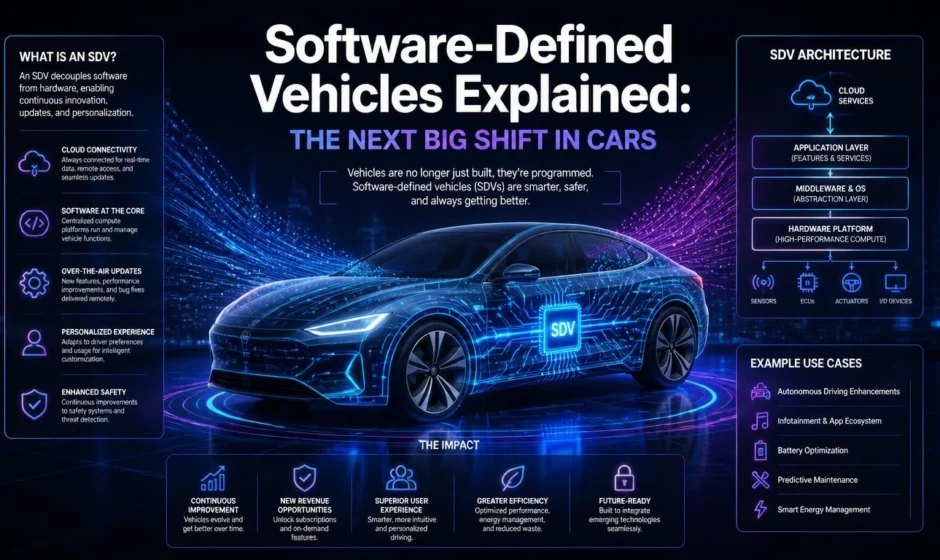

For most of automotive history, a car’s capabilities were locked in the moment it left the factory. Adding a new feature meant installing new physical hardware. In 2026, that’s changing fundamentally, and it’s one of the defining shifts covered in our broader look at 2026 automotive trends. At its core, a software-defined vehicle (SDV) is a car whose capabilities can be introduced or upgraded over time through software, without changing any physical components — deployed via over-the-air updates, much like a smartphone.
The Fundamental Architecture Shift
Traditional vehicles are built around Electronic Control Units (ECUs) — individual hardware boxes, each dedicated to a single function like managing windows, climate control, or braking. Once built, an ECU’s function was essentially fixed for the vehicle’s lifetime; adding a feature like adaptive cruise control often meant physically installing an entirely new module. This approach, while proven, is expensive, heavy, and inherently resistant to being upgraded after the vehicle is sold.
SDVs decouple hardware from software entirely. Rather than dozens of single-purpose ECUs scattered throughout the car, modern SDV architecture increasingly relies on zonal architecture. A smaller number of powerful zone controllers, each managing multiple functions within a physical area of the vehicle, all connecting to a central compute platform. This hierarchical structure combines the reliability benefits of distributed systems with the flexibility of centralized computing. And it’s what actually makes meaningful over-the-air updates possible in the first place.
What Over-the-Air (OTA) Updates Actually Cover
OTA updates let manufacturers remotely update a vehicle’s software, firmware, and digital services without requiring a service center visit — improving performance, fixing bugs, adding entirely new features, and patching security vulnerabilities. These updates generally fall into two categories: firmware over-the-air (FOTA), which updates lower-level embedded systems, and software over-the-air (SOTA), which updates higher-level applications and features. The IEA defines “near-full” OTA capability as the ability to remotely update almost all of a vehicle’s software components, including powertrain control, battery management systems, and advanced driver assistance systems (ADAS) — a genuinely comprehensive level of remote updatability that only a handful of manufacturers currently offer.
Why This Matters for Manufacturers
For automakers, SDVs fundamentally change the business relationship with a vehicle after it’s sold. Rather than a one-time transaction, an SDV lets manufacturers extend customer engagement well beyond the initial purchase. Introducing new features, improving performance, and patching security issues throughout a vehicle’s lifetime rather than treating the car as a finished, unchanging product from day one. This creates a genuine opportunity for ongoing brand loyalty and, in some cases. Entirely new revenue models built around feature updates or subscriptions delivered after the sale.
What This Means for Car Buyers
For everyday buyers, the practical implications are significant, even if the underlying architecture stays invisible day to day:
- A car bought today can genuinely improve over time — new features, better performance, and security patches arriving the same way a phone’s operating system updates, rather than requiring a trade-in to access newer capabilities.
- Fewer trips to the service center for issues that can now be resolved remotely through a software patch rather than requiring an in-person diagnostic and repair.
- A meaningfully different ownership experience compared to buying a traditional, hardware-locked vehicle — worth factoring into a purchase decision alongside the EV, hybrid, and gas comparison covered elsewhere in this category, since SDV capability increasingly varies by manufacturer and model regardless of powertrain type.
SDVs Aren’t Limited to Electric Vehicles
A common misconception worth correcting directly. Software-defined vehicles are not simply another name for electric vehicles, nor are they just conventional cars with more software bolted on. The shift represents a genuine architectural transformation that applies across powertrain types. A gas or hybrid vehicle can be built on a software-defined architecture just as much as an EV can, even though EVs, built without the constraints of decades-old mechanical platforms. Have often served as the more natural starting point for manufacturers adopting this approach first.
The Real Challenges Behind the Shift
Building genuine SDV capability isn’t simple, and the industry is still working through real complexity. A production-grade OTA platform requires secure communication protocols, careful update orchestration, extensive testing, ongoing monitoring, reliable rollback mechanisms if an update fails, and fleet-wide observability across potentially millions of vehicles. Spanning embedded software, cloud platforms, mobile applications, data engineering, cybersecurity, and user experience design all at once. Security is a particularly serious concern: a vehicle that can be updated remotely is also, in principle. A vehicle that could be attacked remotely if security protocols aren’t rigorously maintained. Making cybersecurity a foundational requirement rather than an afterthought in SDV development.
Ending Lines
Software-defined vehicles represent one of the most significant structural shifts in how cars are designed, built, and owned in decades. Moving the industry away from fixed, hardware-locked capability toward continuously evolving, software-updatable platforms. For manufacturers, it’s a fundamental rethink of the relationship with customers after a sale. For buyers, it means a car purchased in 2026 may genuinely function differently. And better a year or two down the road, without ever visiting a dealership. A meaningful shift in what “buying a car” actually means going forward.
Frequently Asked Questions
What is a software-defined vehicle (SDV)?
An SDV is a vehicle whose capabilities can be introduced or upgraded over time through software, deployed via over-the-air updates. Rather than being fixed at the point of manufacture like traditional hardware-based vehicles.
Are software-defined vehicles the same as electric vehicles?
No. SDVs represent an architectural approach that can apply to gas, hybrid, or electric vehicles. EVs have often adopted software-defined architecture earlier since they aren’t built on decades-old mechanical platforms. But the concepts are independent of powertrain type.
What is the difference between FOTA and SOTA updates?
FOTA (firmware over-the-air) updates lower-level embedded systems, while SOTA (software over-the-air) updates higher-level applications and features. Both fall under the broader category of over-the-air updates used in software-defined vehicles.
What is zonal architecture in cars?
Zonal architecture refers to a vehicle design using a smaller number of powerful zone controllers. Each managing multiple functions within a physical area of the car. All connecting to a central compute platform, replacing the older approach of dozens of single-purpose electronic control units.
Why is cybersecurity a major concern for software-defined vehicles?
Because SDVs can be updated remotely, they can, in principle, also be vulnerable to remote attacks if security protocols aren’t rigorously maintained. Making robust cybersecurity a foundational requirement rather than an optional add-on in SDV development.