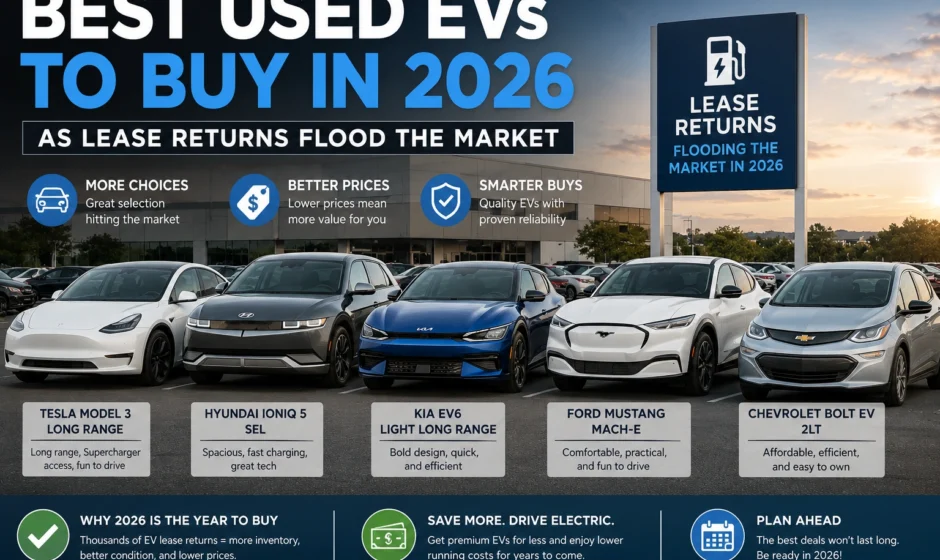

A genuinely unusual moment has arrived in the used car market: roughly 329,000 EV leases are expected to return in 2026 alone. A part of a broader wave of nearly 3 million total US vehicle leases maturing this year, up from about 2.4 million in 2025. Combined with steep EV depreciation, this is creating some of the strongest used EV value in years. Directly connected to why new EV sales have been struggling in the US even as the used market booms.
Why Used EVs Have Gotten So Cheap
EVs have historically depreciated roughly 13% faster than comparable gas vehicles. Driven substantially by widespread buyer concern about battery degradation, despite battery and motor failures actually being quite rare. That depreciation gap has narrowed used EV prices to within about $1,300 of comparable used gas vehicles on average. The narrowest gap on record while used EV sales climbed roughly 12% year-over-year in the first quarter of 2026 alone as prices softened and lease-return supply expanded.
Interestingly, the market isn’t behaving uniformly since the federal tax credit expired on September 30, 2025. Used EV prices excluding Tesla fell roughly 3.6% in early 2026. While used Tesla values actually rose about 4.3% over the same period, with some individual Tesla models climbing considerably more. That divergence suggests brand-specific factors reputation, charging network access. And perceived reliability are increasingly driving used EV pricing as much as the broader post-tax-credit market shift.
What’s Actually Available Right Now
Reported pricing on specific used EVs has moved fast in 2026. And figures below reflect recent reporting rather than fixed prices. But they illustrate just how far values have fallen at every price tier:
- Around $15,000-$20,000: Tesla Model 3 and Chevrolet Bolt have been reported trading in this range. With base Hyundai Ioniq 5 and Kona EV models landing nearby.
- Around $25,000-$30,000: The Ford Mustang Mach-E has averaged roughly $28,970 according to CarGurus data. While a well-equipped Chevrolet Blazer EV has been reported as low as $25,000.
- Around $35,000: Buyers at this level have reportedly found options including the Cadillac Lyriq, Mercedes EQE SUV, BMW i4, and even a Tesla Model 3 Performance.
- Around $38,000: The BMW iX — a roughly 300-mile luxury SUV that started well over $100,000 new has shown up at this price point due to a combination of steep original discounting and typical used-luxury depreciation.
Which Models Face the Steepest Continued Softening
Not every used EV is depreciating at the same pace, and some further softening is expected before prices stabilize. The highest-volume lease returns the Ford Mustang Mach-E, Volkswagen ID.4, Chevrolet Bolt EUV, and Hyundai Ioniq 5 are projected to see an additional 5-10% price softening in the second half of 2026 simply due to the sheer volume hitting the market at once. Luxury EVs face even steeper absolute-dollar drops: EQS, iX, Lucid Air, and Lyriq leases, largely running 24-month terms. Are seeing a concentrated wave of 2024-cohort returns in 2026, with used EQS and iX inventory potentially seeing another $5,000-$8,000 in price erosion before stabilizing.
Which EVs Hold Their Value Best
For buyers thinking about resale down the line, value retention varies dramatically by model. The Tesla Model Y has held onto roughly 64% of its value after two years. And the Rivian R1S has performed even better at around 73% both considerably stronger than the segment average. On the other end, the Lucid Air has lost over half its value in the same period. Illustrating just how wide the gap in depreciation performance can be even within the EV category itself.
Before You Buy: What to Actually Check
A heavily discounted used EV isn’t automatically a bargain, and it isn’t automatically a problem. The real question is whether the vehicle’s usefulness survives once the initial market excitement around its original price fades. A few checks matter more for used EVs than for a typical used gas car:
- Battery health, not just mileage. Since there’s no single industry-standard method to independently verify battery health. Get an independent assessment specifically for this rather than relying on odometer reading alone. The same way you’d get an engine inspected on a used gas car.
- Charging standard compatibility, particularly for older models as the industry consolidates around the NACS charging connector. Confirm what adapter or charging access a specific used model actually supports before assuming it works seamlessly with current charging networks.
- Remaining battery warranty coverage, since this varies by manufacturer and original purchase date, and meaningfully affects the real risk profile of buying used.
This is also worth weighing against the broader EV vs. hybrid vs. gas cost comparison covered elsewhere in this category. Since a heavily discounted used EV can shift that calculation considerably in the EV’s favor compared to buying new.
When Is the Best Time to Buy?
Industry analysts covering the used EV depreciation trend suggest the fourth quarter of 2026 through the first quarter of 2027 will likely represent the best used EV pricing window in years. Inventory peaking, demand still dampened by the missing federal tax credit. And dealers needing to move certified pre-owned EV inventory before year-end. Buyers who can be patient through the rest of this year may see meaningfully better pricing than what’s available right now.
The Bottom Line
2026’s flood of EV lease returns has created a genuinely rare moment in the used car market real, well-equipped EVs available at prices that would have seemed implausible just two or three years ago, driven by a specific combination of high lease-return volume, steep EV depreciation, and the loss of federal purchase incentives. The opportunity is real, but so is the need for real diligence: checking battery health, confirming charging compatibility, and understanding which specific models are still likely to soften further before settling on a purchase.
FAQs
How many EV leases are returning to the used market in 2026?
An estimated 329,000 EV leases are expected to return in 2026, part of a broader wave of nearly 3 million total US vehicle leases maturing this year.
Why are used EV prices falling faster than used gas car prices?
EVs have historically depreciated roughly 13% faster than comparable gas vehicles, driven substantially by widespread buyer concern about battery degradation, even though battery and motor failures are actually quite rare.
Are used Tesla prices behaving differently from other used EVs?
Yes. Since the federal tax credit expired in September 2025, used EV prices excluding Tesla fell roughly 3.6% in early 2026, while used Tesla values actually rose about 4.3% over the same period.
What should I check before buying a used EV?
Beyond standard used-car checks, verify the battery’s health independently rather than relying on mileage alone, confirm charging standard compatibility (particularly around the NACS connector), and check remaining battery warranty coverage.
When is the best time to buy a used EV in 2026?
Industry analysts suggest the fourth quarter of 2026 through the first quarter of 2027 will likely offer the best used EV pricing, as lease-return inventory peaks and dealers work to move certified pre-owned stock before year-end.