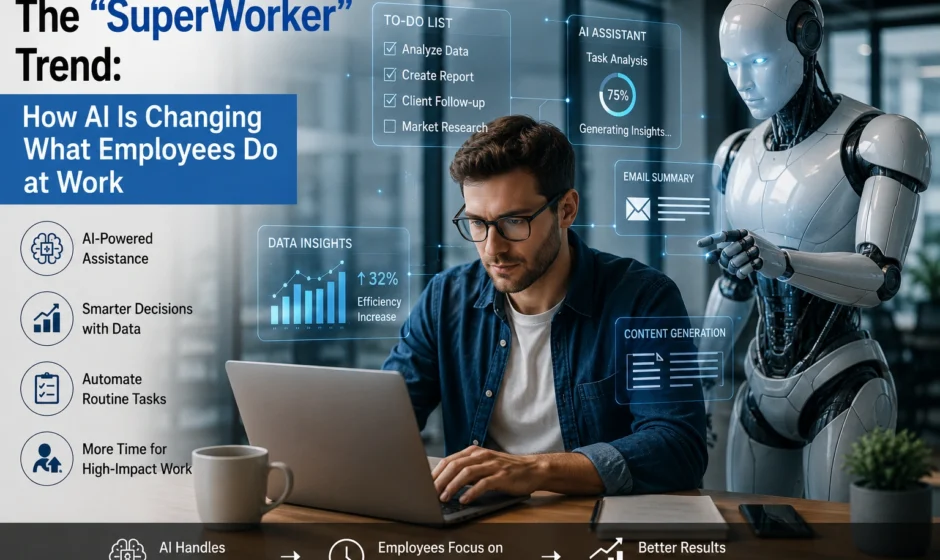

A new category of employee has emerged in workplace research this year. And it’s reshaping how businesses of every size think about talent, productivity, and hiring. HR analyst Josh Bersin coined the term “SuperWorker” to describe an employee who integrates AI into their daily workflow to significantly amplify their own productivity, creativity, and decision-making. And the concept has moved quickly from analyst framework to genuine business strategy in 2026. It’s a natural extension of the broader AI adoption wave already reshaping small businesses this year, applied specifically to what individual employees actually do day to day.
What Is a “SuperWorker,” Exactly?
According to Bersin’s original framing, a SuperWorker is an employee empowered and supported by AI who increases their value, output. And impact by learning to genuinely optimize how they use AI systems in their work. Critically, the concept is explicitly not about using AI to eliminate jobs or cut headcount. It’s about applying AI’s capabilities to outperform competitors through better business processes, richer customer experiences, and more effective internal operations, with a human still very much in the driver’s seat.
The scale of the potential impact is significant: some analyst estimates suggest AI-augmented workflows can expand creativity, speed, and output by 100% to 300%, though how much of that potential actually gets realized depends heavily on how well an organization implements the tools, not just whether it has access to them.
The Historical Pattern Behind This Shift
The SuperWorker concept fits into a longer historical pattern worth understanding. Over the past 35 years, as successive waves of technology have amplified individual worker capability, GDP per worker has risen by roughly 280%, while total employment across that same period declined by about 32%. AI represents an acceleration of that same underlying dynamic — organizations moving progressively from simple AI assistance, to fuller automation, to genuinely agentic workflows, and eventually toward more autonomous systems that increasingly handle entire categories of work rather than single tasks.
This is also where the SuperWorker concept connects directly to the broader shift toward agentic AI happening across the technology landscape: as AI systems gain the ability to take real actions rather than just generate suggestions, the SuperWorker model shifts too — from an employee who uses AI as a tool, toward one who effectively directs a team of AI agents handling repetitive or administrative work, freeing their own attention for judgment calls and creative decisions that genuinely require a human.
Why This Matters Specifically for Small Businesses
Larger enterprises have research teams and consultants studying workforce transformation trends like this one. Small businesses generally don’t, but arguably have more to gain from getting it right. Since a single AI-augmented employee at a small business represents a proportionally much larger share of total output than the same employee would at a large corporation. When digital tools and AI agents handle repetitive or administrative tasks. Small business employees can redirect their attention toward higher-value work client relationships, creative problem-solving. And strategic decisions the kind of work that’s genuinely hard to scale otherwise without adding headcount.
The Real Risk: Access Without Adoption
Here’s the important caveat that separates the SuperWorker concept’s promise from its actual delivery. Simply giving an employee access to AI tools doesn’t automatically make them a SuperWorker. The framing draws a deliberate parallel to talented employees generally. A skilled worker can still be held back when an organization doesn’t set them up to succeed. And the same holds true for AI. This connects directly to the training gap already identified among small businesses adopting AI more broadly. Tools without genuine training and a real usage strategy tend to produce inconsistent, underwhelming results, while the same tools paired with deliberate skill-building produce measurably better outcomes.
HR’s Expanding Role in the SuperWorker Era
For businesses with any kind of HR function, however informal, the SuperWorker trend raises the strategic stakes considerably. Rather than treating HR as a purely administrative function. The emerging view treats it as a strategic architect of how AI actually gets integrated into how people work day to day. Identifying which tasks are genuinely worth augmenting with AI, ensuring employees receive real training rather than just tool access. And rethinking how performance itself gets measured once routine task volume is no longer a meaningful productivity signal on its own.
The Bottom Line
The SuperWorker trend represents a genuine shift in what “a good employee” means in 2026. Not necessarily someone with the most raw experience. But someone who has learned to genuinely direct AI tools toward real business outcomes rather than treating them as a novelty. For small businesses specifically, closing the gap between simply having access to AI tools and actually training employees to use them well may be one of the highest-leverage moves available this year — arguably more impactful than which specific AI tool gets purchased in the first place.
FAQs
What is a “SuperWorker”?
A SuperWorker is an employee who integrates AI into their daily workflow to significantly increase their own productivity, creativity, and decision-making, a concept coined by HR analyst Josh Bersin, explicitly focused on augmenting human capability rather than eliminating jobs.
Is the SuperWorker trend about replacing employees with AI?
No. The concept explicitly rejects using AI to eliminate jobs or cut costs, focusing instead on applying AI capabilities to help existing employees outperform through better processes, decisions, and customer experiences.
How much can AI actually improve individual worker productivity?
Some analyst estimates suggest AI-augmented workflows can expand creativity, speed, and output by 100% to 300%. Though actual results depend heavily on how well an organization trains and supports employees in using the tools.
Why does the SuperWorker trend matter for small businesses specifically?
A single AI-augmented employee represents a proportionally larger share of total output at a small business than at a large enterprise. Meaning small businesses may have more to gain from effectively adopting this approach relative to their size.
Is simply giving employees access to AI tools enough to create SuperWorkers?
No. Access alone doesn’t guarantee results, similar to how a talented employee can be held back without proper organizational support. Genuine training and a clear usage strategy are what actually separate strong outcomes from inconsistent ones.