
Small businesses have long been told they’re too small to be worth a hacker’s attention. That assumption has never been more wrong. In 2026, cybercriminals increasingly favor small businesses precisely because they typically carry fewer dedicated security resources than large enterprises. While still holding valuable customer data and payment information. This isn’t a topic that fits neatly into “IT problems” anymore. It’s a genuine business continuity issue, and one worth understanding alongside the broader small business trends shaping 2026.
Phishing Remains the Number One Threat — and AI Is Making It Worse
Phishing and email scams remain the single biggest cybersecurity concern for small business owners, cited by 43.4% of respondents in a recent Small Business Expo survey. More than twice the rate of the next-highest concern, software vulnerabilities (18.0%). What’s changed in 2026 is how convincing these attacks have become. 72% of workers surveyed say phishing attempts feel more convincing than a year ago specifically because of AI-generated language. And 57% say AI-written messages make phishing meaningfully harder to spot because they now read as genuinely professional rather than obviously suspicious. Nearly 65% of workers say it’s somewhat or very likely that an AI-generated message could successfully impersonate a coworker. And 42% admit they’ve already trusted a message specifically because it sounded like someone they regularly work with.
This connects directly to the broader shift in how AI is reshaping small business operations. The same accessible AI tools helping small businesses grow are simultaneously helping attackers craft far more convincing scams than the poorly-worded phishing emails of just a few years ago.
Ransomware Disproportionately Targets Smaller Businesses
Ransomware remains one of the fastest-growing and most damaging attack types, and small businesses bear an outsized share of the risk. 80% of ransomware attacks target businesses with fewer than 1,000 employees, reflecting attackers’ preference for organizations less likely to have robust backup systems and dedicated incident response capability. Industry estimates on the average financial impact of a breach vary depending on methodology and what’s included (direct losses, downtime, recovery costs, reputational damage), but multiple 2026 industry reports place average breach-related losses well into six figures for affected small businesses — a scale that can be genuinely business-ending for an owner without adequate preparation or insurance.
Awareness Is High, But Preparedness Lags Behind
Perhaps the most important gap in this entire picture: small business owners generally recognize the threats they face, but confidence in their ability to actually defend against them remains low. Only 19.5% of surveyed small business owners say they feel very prepared for a cyberattack, despite the vast majority correctly identifying phishing as their top risk. That gap between awareness and actual readiness — rather than ignorance of the threat itself — is where most small business cybersecurity failures actually originate.
Which Industries Face the Highest Risk
Cybersecurity risk isn’t distributed evenly across small business sectors. Healthcare practices and healthcare-adjacent businesses face elevated exposure because of the sensitivity of the data they hold — small medical practices face the same threat actors targeting major hospital systems, without matching security infrastructure. Professional services firms, including legal, accounting, insurance, and financial services businesses, face similar elevated risk due to the sensitive client data and financial information they routinely handle.
Practical Steps Small Businesses Can Take
The organizations facing the highest actual risk, according to industry analysis, aren’t necessarily the ones with no security awareness at all — they’re often businesses that self-assess as reasonably prepared but haven’t implemented genuinely foundational protections. A few specific, high-impact steps stand out:
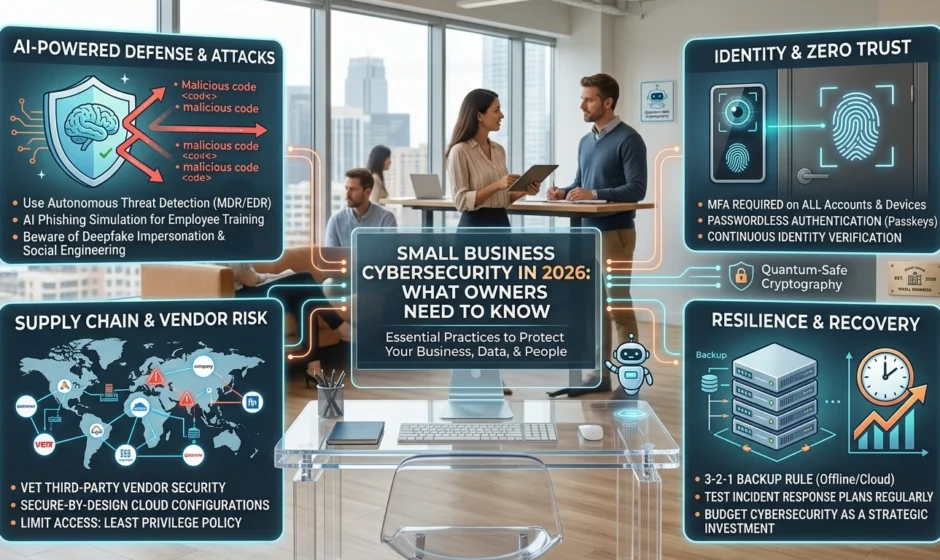
- Implement multi-factor authentication (MFA) across all business accounts, particularly email and financial systems — one of the single highest-return security investments available.
- Run regular, realistic employee training on phishing recognition, updated to reflect how convincing AI-generated scams have become, rather than relying on outdated “spot the bad grammar” advice.
- Maintain a basic incident response plan so that if an attack does occur, the business has a clear, rehearsed process rather than a scramble.
- Back up data regularly and test recovery, since ransomware recovery depends entirely on whether clean backups actually exist and work when needed.
- Vet third-party vendors’ security practices, since vendor and supply chain risk remains a meaningful and often overlooked entry point for attacks on otherwise well-protected businesses.
For a deeper technical walkthrough of foundational protections, our Technology category’s small business cybersecurity basics guide covers implementation specifics in more depth.
The Bottom Line
Small business cybersecurity in 2026 isn’t primarily a technology problem — it’s a preparedness gap. Most owners already know phishing is their biggest threat; what’s missing, for the majority, is the specific, foundational security measures (MFA, real employee training, tested backups) that would meaningfully close that gap. As AI continues to make phishing and social engineering more convincing on the attacker’s side, investing in those fundamentals has become less of an IT afterthought and more of a core business survival decision.
Frequently Asked Questions
What is the biggest cybersecurity threat to small businesses in 2026?
Phishing and email scams remain the top concern, cited by 43.4% of small business owners, more than twice the rate of the next-highest concern, software vulnerabilities.
Why is phishing harder to detect in 2026 than in previous years?
AI-generated language has made phishing emails significantly more convincing, with 72% of surveyed workers saying phishing attempts feel more convincing than a year ago, and 57% saying AI makes these messages harder to spot because they now read as genuinely professional.
Are small businesses actually at higher risk than large companies?
Yes, in several respects. Small businesses often have fewer dedicated security resources than large enterprises, and 80% of ransomware attacks specifically target businesses with fewer than 1,000 employees.
What’s the single most effective cybersecurity step a small business can take?
Implementing multi-factor authentication (MFA) across business accounts is widely considered one of the highest-return, most accessible security investments a small business can make, alongside regular employee phishing awareness training.
Which small business industries face the highest cybersecurity risk?
Healthcare practices and professional services firms (legal, accounting, insurance, financial services) face elevated risk due to the sensitive personal and financial data they routinely handle.