
Few topics in the car industry attract as much hype and confusion as self-driving technology, and marketing names don’t help — a system called “Full Self-Driving” sounds like it should mean the car drives itself, but it doesn’t, at least not by the industry’s own technical standard. The confusion cuts through cleanly once you understand the actual classification system every automaker, regulator, and safety agency uses: the SAE’s six levels of driving automation, from Level 0 to Level 5. Here’s what each level genuinely means, and exactly where the technology actually stands today. A useful companion to our explainer on software-defined vehicles, since advanced autonomy depends entirely on that same underlying software architecture.
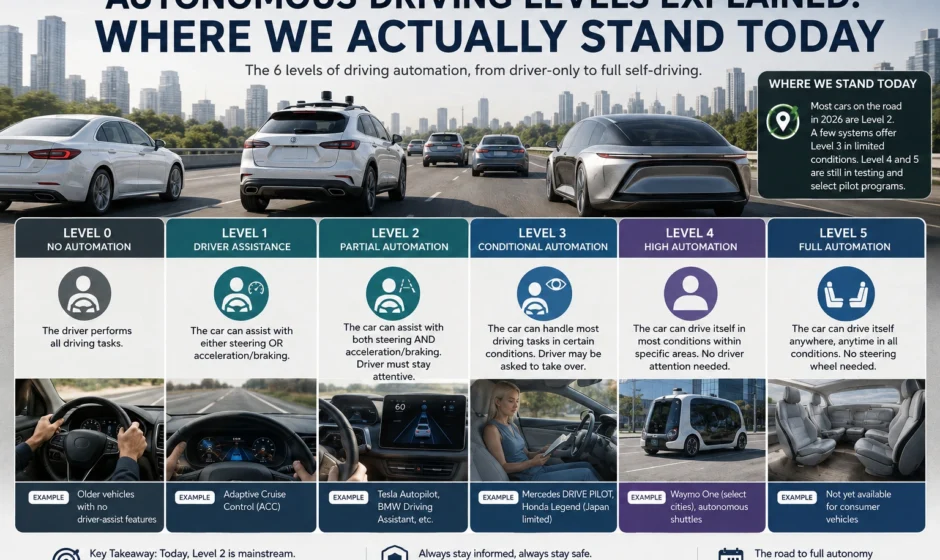
The Six SAE Levels, Explained Simply
Level 0 — No Automation. The driver handles everything: steering, braking, accelerating. Basic warnings like blind-spot alerts and forward-collision warnings still fall under Level 0, since they only alert — they don’t actually take action.
Level 1 — Driver Assistance. The system controls exactly one function at a time — either steering or speed, never both simultaneously. Standard adaptive cruise control is the clearest everyday example.
Level 2 — Partial Automation. The system can control steering and speed at the same time, but the driver must supervise constantly and remains fully responsible for the vehicle. This is genuinely the mainstream standard for new cars in 2026 — the vast majority of consumer vehicles on the road today sit here, whatever their marketing name suggests.
Level 3 — Conditional Automation. This is the real dividing line. At Level 3, the car handles the complete driving task under specific conditions, and the driver can legitimately look away or engage in other activities — but must be ready to retake control within a defined warning period if the system requests it. Sleeping is still explicitly not allowed at Level 3.
Level 4 — High Automation. The vehicle handles all driving tasks with no human fallback required, but only within a defined operational area (its “operational design domain”). If the system hits a situation it can’t handle, it brings itself to a safe stop rather than asking a human to intervene — because at Level 4, there may not be a human behind the wheel at all.
Level 5 — Full Automation. The vehicle could drive anywhere, in any condition a human could handle, with no geographic or situational limits. This level does not exist in any commercially available form yet.
Where Popular 2026 Systems Actually Sit
Here’s where the marketing names and the technical reality genuinely diverge:
- Tesla Autopilot and Full Self-Driving are officially classified as Level 2 by NHTSA, despite the name — the driver must supervise constantly and remains legally responsible at all times.
- GM Super Cruise, Ford BlueCruise, and Hyundai Highway Driving Assist 2 are all Level 2 hands-free systems, widely considered among the most refined and proven in the category.
- Rivian’s Universal Hands-Free system, expanded significantly in 2026, works across more than 3.5 million miles of roads in North America — including rural two-lane roads and suburban streets, not just mapped highways — using a custom processor handling five billion pixels of sensor data per second across eleven cameras and five radars. It’s still Level 2+, and notably, it does not stop for traffic lights or stop signs, an important limitation for anyone assuming “hands-free” means “fully autonomous.”
- Mercedes-Benz Drive Pilot is the only system currently holding genuine Level 3 legal certification for consumers, available in California and Nevada, allowing drivers to legally use a phone or watch a video under specific, limited highway conditions. Honda has announced its 0 Series EVs will carry Level 3 capability in other markets starting in 2026, though regulatory hurdles continue to cloud its US availability specifically.
- Waymo operates true Level 4 driverless robotaxi service across Phoenix, San Francisco, Los Angeles, and Austin, having completed over 14 million fully autonomous trips and logged more than 127 million rider-only miles — genuinely no human safety driver required within its operating areas.
- Zoox runs Level 4 robotaxi service in San Francisco and Las Vegas, while Baidu’s Apollo Go operates more than 1,000 driverless robotaxis across 15 Chinese cities, with expansion into Dubai, Germany, and the UK planned for 2026.
Why Level 3 Specifically Remains So Rare
Level 3 sits at a genuinely awkward middle point that makes it harder to deploy than either Level 2 or Level 4. Unlike Level 2, where the driver stays actively engaged throughout, Level 3 asks drivers to disengage from monitoring — and then asks them to snap back to full attention within a short warning window if the system requests it. Multiple automakers have expressed real concern that this handoff creates a genuine safety problem: drivers who grow accustomed to not paying attention may not be prepared to safely retake control when actually needed. That risk is part of why so few Level 3 systems have reached the consumer market despite the underlying technology existing for several years — Goldman Sachs estimates only up to 10% of global new car sales will be Level 3 by 2030, a modest projection given how long the technology has already been available.
What This Means for Car Buyers
If a system is marketed with language suggesting full autonomy, it’s worth checking its actual SAE classification rather than trusting the name alone — as the Tesla example makes clear, a Level 2 system can carry marketing language that sounds considerably more capable than its actual legal classification and required driver responsibility. For anyone specifically shopping for hands-free convenience on highways, GM Super Cruise and Ford BlueCruise are widely regarded as among the most mature, dependable Level 2 systems currently available, while genuinely autonomous point-to-point travel remains limited to robotaxi services operating in specific cities rather than something available in a personally owned vehicle.
The Bottom Line
Despite years of hype, nearly every consumer car on the road in 2026 sits at Level 2 — you’re still fully responsible, still required to watch the road, regardless of how sophisticated the system’s marketing name sounds. Genuine Level 3 remains legally available in only a handful of places through a single manufacturer, and true driverless Level 4 technology exists today only in the form of robotaxi services in specific cities, not personally owned vehicles. Understanding this gap between marketing language and actual SAE classification is the single most useful thing a car buyer can know before assuming any system means the car can genuinely drive itself.
Frequently Asked Questions
Is Tesla’s Full Self-Driving actually Level 3 or higher?
No. Despite its name, Tesla Autopilot and Full Self-Driving are officially classified as Level 2 by NHTSA, meaning the driver must supervise constantly and remains fully responsible for the vehicle at all times.
What car has real Level 3 autonomous driving in 2026?
Mercedes-Benz Drive Pilot is currently the only system with genuine Level 3 legal certification for consumers, available in California and Nevada under specific highway conditions.
What’s the difference between Level 3 and Level 4 autonomous driving?
At Level 3, the driver must be ready to retake control if the system requests it within a set warning period. At Level 4, the vehicle handles all driving tasks within its operating area with no human fallback required, and brings itself to a safe stop if it encounters a situation it can’t handle.
Does any car have real Level 5 full autonomy in 2026?
No. Level 5, meaning a vehicle that could drive anywhere under any condition a human could handle, does not exist in any commercially available form yet.
Which companies operate real driverless robotaxis in 2026?
Waymo operates Level 4 driverless service in Phoenix, San Francisco, Los Angeles, and Austin, Zoox operates in San Francisco and Las Vegas, and Baidu’s Apollo Go runs over 1,000 driverless robotaxis across 15 Chinese cities.