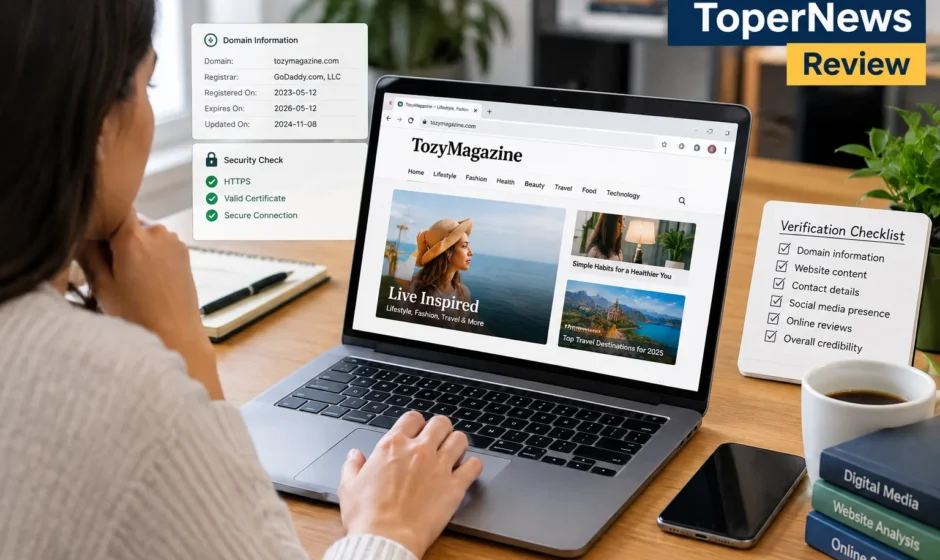

Search “tozymagazine.com” and you’ll find page after page of near-identical reviews, each repeating the same checklist: it has SSL, it has a Contact page, the domain is young, ownership info is limited, conclusion — “probably legit, use normal caution.” That’s not wrong, but it’s not especially useful either. This piece takes a different approach: rather than repeating that checklist, it walks through how to actually verify a site like this yourself, using Tozymagazine.com as the real, worked example.
What Tozymagazine.com Actually Is Right Now
Based on its own published About page, Tozy Magazine started as a narrow, occasion-focused site — content built around finding the right words for birthdays, weddings, anniversaries, and thank-you messages. That’s a genuinely specific, coherent niche.
The site you’d land on today looks very different. Its current homepage and archive span business, health, technology, home improvement, finance, cryptocurrency, and law, alongside its original occasion-based content. Recent published articles have covered subjects as varied as stove-top cleaning, cardio training, small-business client acquisition, pension planning, motorcycle accident claims, utility-scale battery storage, and aquaculture equipment.
That’s not a small content expansion — it’s a complete shift in what the publication actually is, happening within roughly two years of the site’s registration.
Why That Shift Matters More Than the Standard Checklist
Most reviews of sites like this focus on static technical signals: does it have HTTPS, does it have a Privacy Policy, is the domain young. Those are worth checking, but they don’t tell you much on their own — plenty of low-quality content mills have all three.
What actually tells you more is the pattern of change in a site’s content and purpose. A publication that pivots from a specific, personal niche (occasion-based writing) into an extremely broad, commercially-oriented topic spread (finance, law, health, crypto) in under two years is showing a recognizable pattern: content built to capture search traffic across many high-value topics, rather than genuine editorial focus or specific expertise. That doesn’t automatically make it a scam — but it does mean you shouldn’t treat any individual article on the site as automatically authoritative just because the site itself isn’t flagged as malicious.
A Real Method for Checking a Site Like This Yourself
Here’s a more useful checklist than “does it have SSL,” built around what actually distinguishes a legitimate-but-generic content site from something worth more caution:
1. Check whether the About page matches the actual content
Tozymagazine.com’s About page still centers on its original occasion-based mission — but the homepage is dominated by unrelated commercial topics like pensions and legal claims. A real mismatch between stated purpose and actual output is a genuine signal worth noting, even if it’s not proof of anything malicious on its own.
2. Look at author history, not just bylines
Checking a site’s author archive — not just the byline on one article — tells you whether content is written by a small number of people covering an implausibly wide range of specialist topics (finance, law, health, aquaculture) in a short window. Tozymagazine.com’s author archive shows this exact pattern: broad topic coverage under a small number of author names, publishing frequently across genuinely unrelated specialist fields.
3. Check whether ownership is disclosed clearly, not just present
Tozymagazine.com has a Contact page and an About page mentioning a founder — but doesn’t clearly name that person, and public WHOIS ownership data is not available. Having a contact form is not the same as having transparent ownership. The distinction matters: a real, accountable publication will typically make it easy to find out who is actually responsible for what’s published.
4. Search for the domain plus “review” and read the pattern, not just the content
If a domain search returns a wall of nearly identical “is it legit” articles from unrelated blogs, that’s worth noticing in itself. It usually means either the site is genuinely popular enough to attract organic curiosity, or that it’s part of a recognizable content ecosystem where similar sites get reviewed by similarly-templated blogs — sometimes even by related networks. Neither confirms wrongdoing, but a wall of interchangeable reviews should lower your confidence in any single one of them, including this kind of piece.
5. Treat “not flagged as malicious” as a low bar, not a conclusion
Third-party checkers (ScamAdviser and similar tools) confirming a site isn’t flagged for malware or phishing is a genuinely useful, but narrow, signal. It tells you the site probably won’t infect your device. It tells you nothing about whether a specific article’s financial, legal, or health claims are accurate — that requires checking the actual content, not the domain’s technical safety score.
So, Is Tozymagazine.com Legit?
Based on available evidence: it’s a functioning, actively publishing website, not an obvious scam. It has working infrastructure (SSL, a Contact page, a Privacy Policy), and third-party safety checkers haven’t flagged it as malicious. There’s no indication it’s attempting to steal information or run a financial scam.
At the same time, its rapid pivot from a narrow personal-writing niche into broad, high-stakes topics like finance, law, and health, combined with limited ownership transparency, means individual articles shouldn’t be treated as an authoritative source on those specific subjects. Treat it the way you’d treat any general-interest content site with unclear editorial oversight: fine for casual browsing, worth double-checking before acting on anything specific and consequential — a financial decision, a legal claim, a health recommendation.
The Bottom Line
The more useful question isn’t “is this one specific site legit” — it’s “how do I evaluate any unfamiliar website I land on.” The five checks above (About-page/content match, author history, real ownership transparency, the review-pattern check, and treating “not malicious” as a floor rather than a conclusion) work for any site like this, not just Tozymagazine.com. That’s a genuinely more durable skill than memorizing one site’s specific safety verdict.
FAQs
Is Tozymagazine.com a scam?
No clear evidence indicates it’s a scam. It’s an active, functioning website with standard infrastructure like SSL and a Contact page, and third-party safety checkers haven’t flagged it as malicious.
Why did Tozymagazine.com’s content change so much?
The site originally focused on occasion-based writing (birthdays, weddings, anniversaries) but has since expanded into a much broader mix of business, health, finance, and legal content, a pattern common among content sites optimizing for wider search traffic.
Can I trust the financial or health advice on Tozymagazine.com?
Exercise caution. General information sites covering many unrelated specialist topics, without clearly named subject-matter authors, shouldn’t be treated as an authoritative source for consequential financial, legal, or health decisions.
Why are there so many “is it legit” reviews of the same website?
A wall of near-identical reviews often reflects either genuine organic curiosity about an unfamiliar site, or a recognizable content ecosystem where similar sites are reviewed using similar templates. It’s worth noticing as a pattern, though it doesn’t confirm anything on its own.
What’s a better way to check if any unfamiliar website is safe?
Check whether the About page matches the actual content, review the site’s author history for implausible topic breadth, look for real (not just present) ownership transparency, and treat “not flagged as malicious” as a baseline rather than a full endorsement.