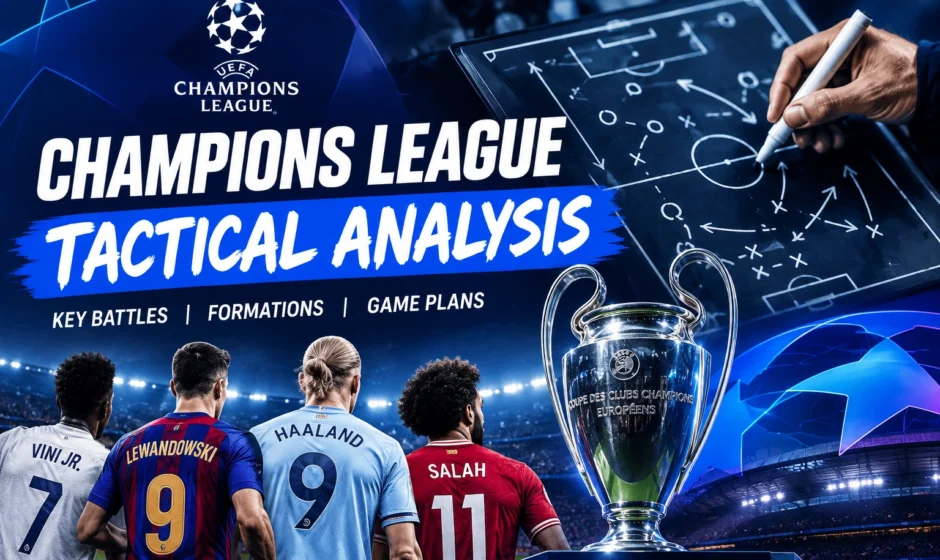

Odds sheets and power rankings tell you who’s favored, but they don’t always tell you why a team’s actual style gives it a real path to the title, or exposes a weakness that talent alone can’t paper over. As the 2026/27 Champions League league phase gets underway, alongside September’s other biggest sporting events, here’s a tactical breakdown of this year’s genuine contenders — not just who’s ranked where, but what actually separates them on the pitch.
PSG: Continuity Is the Real Weapon, Not Just Talent
Paris Saint-Germain enter as back-to-back champions, having beaten Inter 5-0 in 2025 and then defended the title against Arsenal on penalties after a 1-1 draw in Budapest — becoming the first club since Real Madrid’s 2016-18 run to successfully retain the trophy. What actually makes PSG dangerous defending a title isn’t raw individual talent alone, though a core of Ousmane Dembélé, Khvicha Kvaratskhelia, Vitinha, João Neves, Achraf Hakimi, and Nuno Mendes provides plenty of that. It’s continuity. A squad that’s already won together twice has internalized the specific decision-making patterns — when to press, when to drop into a block, who covers for whom on a defensive transition — that newer squads are still working out in real time. That kind of shared understanding is genuinely difficult to replicate through talent acquisition alone, and it’s the real edge defending champions carry into a new campaign.
Real Madrid: Individual Brilliance Still Searching for Structure
Real Madrid enter as the bookmakers’ frontrunner according to markets reported across BBC Sport and ESPN, and the case is straightforward on paper — no club has won the competition more times, and a squad featuring Kylian Mbappé, Vinícius Júnior, and Jude Bellingham has enough individual quality to trouble anyone. But talent and tactical balance aren’t the same thing, and Madrid’s specific challenge — figuring out how to prevent Mbappé and Vinícius from occupying the same attacking spaces — is a genuine structural problem, not simply a matter of adding more skill. Bayern eliminated Madrid in last season’s quarterfinals specifically by exploiting exactly this kind of spatial overlap; whether Madrid has actually solved it, rather than simply having enough individual quality to occasionally overcome it, is the real question shaping their campaign.
Bayern Munich: The Most Structurally Dominant Squad in Germany
Vincent Kompany’s Bayern side enters on the back of a genuinely dominant domestic campaign — 89 points and 122 goals across 34 Bundesliga matches — and reached the Champions League semifinals before a dramatic 6-5 aggregate defeat to PSG. That semifinal result is worth understanding tactically rather than dismissing as a near-miss: a 6-5 aggregate scoreline reflects a team capable of matching elite opposition attack-for-attack, but without quite the defensive discipline to close out a two-legged tie against the eventual champion. Bayern remain structurally dominant within their own league, and the real question is whether that dominance translates into the kind of controlled, patient execution that European knockout football specifically rewards, as opposed to the more open, high-scoring games their domestic dominance sometimes produces.
Arsenal: Heartbreak, Experience, and Unfinished Business
Arsenal came within a penalty shootout of their first-ever Champions League title last season, and from a player’s perspective, that specific kind of near-miss carries real weight heading into a new campaign — a squad that’s actually been to a final knows exactly what that stage demands, in a way that talented teams without that specific experience simply don’t yet. Statistical models reportedly place Arsenal as the first club to break above a 10% title probability outside the very top tier of favorites, reflecting genuine respect for a squad that’s proven it can go the distance, even without having closed it out. The Gunners also carry the psychological weight of a 22-year domestic league title drought recently ended, adding a different kind of hard-won confidence to their European campaign, distinct from simply arriving with talent.
Liverpool and Manchester City: Genuine Quality, Real Questions
Liverpool’s European campaign ended in a quarterfinal defeat to PSG last season, and their path back to contention likely depends less on adding star talent and more on solving a specific tactical tension: maintaining defensive stability while still attacking aggressively enough to trouble elite opposition — the same balance question that separates good Champions League teams from ones that actually win it. Manchester City retain the infrastructure and coaching depth to challenge in any given season, a testament to the organizational continuity built under long-term management, even as statistical models currently place them behind Real Madrid and Arsenal in raw title probability. Both clubs are worth watching for how their form connects to the broader Premier League storylines shaping their domestic campaigns this season, since a demanding league schedule has historically taken a toll on English clubs’ European stamina in the competition’s closing stages.
Why the 36-Team Format Rewards Squad Depth More Than Ever
One structural factor worth understanding tactically: under the current format, all 36 clubs play eight genuinely varied league phase matches rather than a small, predictable group. That means squad depth now matters more than at any previous point in the competition’s history — a club with a shallow bench and no cover when injuries hit a key position at the wrong moment is structurally disadvantaged in a way the old group-stage format didn’t punish nearly as severely. The clubs most likely to disappoint this season aren’t necessarily the ones with less talent; they’re the ones with top-heavy squads lacking genuine tactical coherence across a full 22-man rotation.
The Bottom Line
Beneath the power rankings and betting markets, this year’s Champions League contenders each carry a specific, identifiable tactical question rather than a simple talent ranking: can PSG’s continuity outlast the erosion that comes with defending back-to-back titles, can Real Madrid solve a genuine spatial problem in attack, can Bayern convert domestic dominance into knockout-stage discipline, and can Arsenal’s hard-won final experience finally translate into a trophy. Talent gets a club into the conversation — but in a 36-team format that punishes squads without real depth and tactical coherence, it’s these specific structural questions that will actually decide who lifts the trophy in Budapest next June.
Frequently Asked Questions
Who won the 2025-26 Champions League?
Paris Saint-Germain defended their title, beating Arsenal on penalties after a 1-1 draw in Budapest, becoming the first club since Real Madrid’s 2016-18 run to successfully retain the trophy.
Why is Real Madrid considered the favorite despite last season’s quarterfinal exit?
Bookmaker markets favor Madrid due to their historic Champions League success and individual talent, including Mbappé, Vinícius Júnior, and Bellingham, though the club still faces a genuine tactical challenge in balancing its attacking structure.
How did Bayern Munich’s Champions League campaign end last season?
Bayern reached the semifinals before losing to PSG in a dramatic 6-5 aggregate result, despite winning the Bundesliga with 89 points and 122 goals across 34 league matches.
Why does squad depth matter more in the current Champions League format?
Under the 36-team league phase format, every club plays eight genuinely varied matches rather than a small predictable group, meaning a lack of squad depth is punished more severely than under the older format.
How close did Arsenal come to winning the Champions League last season?
Arsenal reached the final and lost to PSG on penalties after a 1-1 draw, their first-ever Champions League final appearance, giving the squad genuine big-game experience heading into this season.