
Getting a traditional bank loan remains genuinely difficult for small businesses in 2026. About a third of applicants at large banks are declined outright. And nearly half of those approved don’t receive the full amount they requested. That friction has pushed a majority of small businesses toward alternative funding sources that didn’t meaningfully exist a decade ago. Here’s what’s actually available, and how to think about matching a funding option to your specific situation. This article explains general financing options and isn’t personalized financial advice. Consider your own numbers carefully, and consult a financial advisor or accountant before committing to a specific funding product.
Just How Big Has the Shift Away From Banks Become?
The scale of this shift is substantial: alternative lenders including online platforms, fintech companies. And revenue-based funding providers have grown from 29% market share in 2023 to 41% in 2026. More than 76% of startups and small businesses now bypass traditional banks entirely for at least some of their financing needs. And the global alternative financing market is estimated at $21.98 billion in 2026, up from $18.28 billion the previous year.
Revenue-Based Financing (RBF)
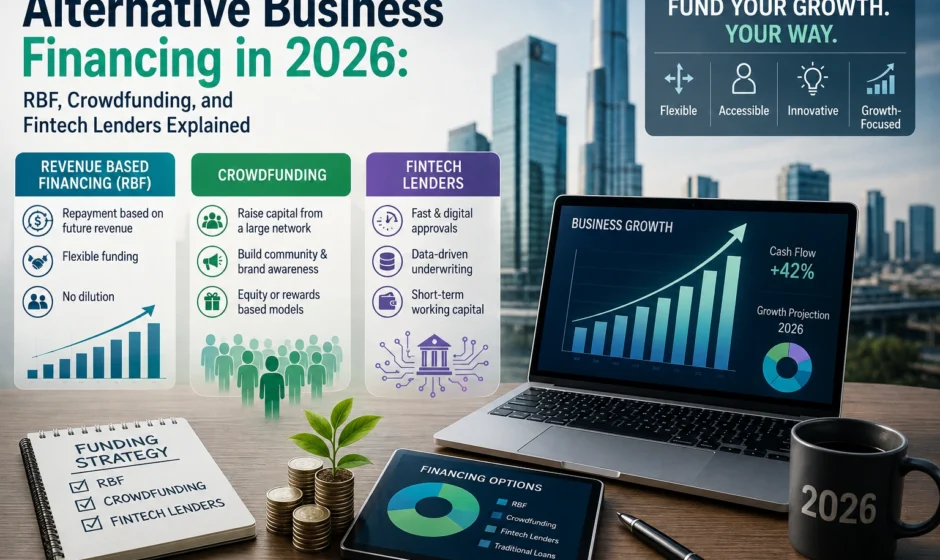
Revenue-based financing has become one of the most significant funding models for businesses with predictable recurring revenue. Particularly SaaS companies and e-commerce brands. Rather than taking on equity dilution or fixed monthly loan payments. RBF ties repayment directly to a business’s actual top-line performance. A business receives capital upfront and repays a fixed percentage of monthly revenue until it has returned the principal plus a predetermined multiple, typically between 1.3x and 2.5x. The appeal is straightforward when revenue grows, payments increase. When revenue dips, payments decrease proportionally, which removes the fixed-payment pressure that can strain a business during a slow month. Industry data suggests revenue-based funding is on track to overtake traditional business lines of credit in total volume among businesses under $1 million in revenue by the end of 2026.
Fintech and Online Lenders
Fintech lenders use alternative data bank statements, and often a direct revenue-feed connection to platforms like Stripe, Shopify, or Amazon. To make automated underwriting decisions considerably faster than a traditional bank. The typical process moves from prequalification (about 5 minutes online) through document upload and automated underwriting to funding, often within 24 hours to 2 weeks total, compared to 30 to 90 days for a typical SBA loan. That speed comes at a real cost, usually in the form of higher rates than a bank would offer. But for a business that needs capital immediately, the trade-off is often worthwhile.
Crowdfunding
Crowdfunding platforms like Kickstarter and Wefunder let businesses raise capital directly from a large number of individuals, either as pre-orders, rewards, or in some cases equity. Beyond the funding itself, a successful campaign validates real product-market fit and builds an initial customer list and marketing momentum that extends well past the campaign period. The most important factor in crowdfunding success isn’t the product idea itself — it’s having an existing audience before the campaign launches; businesses that treat crowdfunding purely as a funding mechanism, without any pre-existing community or story, generally underperform.
Merchant Cash Advances and Invoice Factoring
Two of the fastest ways to access cash carry correspondingly higher costs than most other options on this list. A merchant cash advance provides a lump sum today in exchange for a percentage of future card sales, with repayment automatically deducted daily or weekly. Invoice factoring, by contrast, advances cash against outstanding customer invoices, with approval depending more on customer creditworthiness than the applying business’s own credit profile. Both prioritize speed over cost, making them better suited to short-term cash flow gaps than long-term financing needs.
SBA Loans and CDFI Lenders
Government-backed SBA loans remain the cost leader among small business financing options, with SBA-backed financing reaching a reported $56 billion in 2026, though total volume is projected to end the year down 10-15% due to tighter eligibility thresholds. Community Development Financial Institutions (CDFIs) mission-driven lenders focused on underserved markets offer another path. Often prioritizing community economic impact alongside standard lending criteria.
Matching the Funding Option to Your Business
No single funding source works for every business, and the entrepreneurs succeeding with alternative financing in 2026 are the ones matching mechanisms to their specific cash flow pattern rather than defaulting to whatever their bank happens to offer, or picking based on what sounds trendiest. A few practical starting points:
- Predictable recurring revenue (SaaS, subscription models) generally pairs well with revenue-based financing.
- Physical product businesses with pre-launch buzz are well-suited to crowdfunding, provided an audience already exists.
- Urgent, short-term cash flow needs are better served by fintech term loans or a business line of credit than a slower SBA process.
- Outstanding unpaid invoices make invoice factoring a reasonable bridge option, particularly for B2B service businesses.
- Long-term, lower-cost capital needs still generally favor SBA loans or CDFI financing, despite the slower approval timeline, for businesses that qualify and can wait.
This kind of matching becomes especially relevant once a side hustle has grown past the informal stage and needs real capital to scale — the funding options available to a formally registered business are considerably broader than what’s accessible to an unregistered one.
Conclusion
The small business financing landscape in 2026 has genuinely fragmented beyond the old choice of “bank loan or nothing,” and that fragmentation is a net positive for founders willing to learn the options rather than assuming traditional financing is the only real path. Whether that means revenue-based financing for a subscription business, crowdfunding for a product with an existing following. A fast fintech loan to bridge a short-term gap. The right choice comes down to matching the funding mechanism’s repayment structure to how your specific business’s cash actually flows.
FAQs
What is revenue-based financing?
Revenue-based financing provides upfront capital that’s repaid as a fixed percentage of monthly revenue. Typically 1.3x to 2.5x the amount received, rather than fixed monthly payments or equity. Payments rise and fall with actual business performance.
How fast can I get funding from a fintech lender compared to a bank?
Fintech lenders often fund within 24 hours to 2 weeks using automated, data-driven underwriting. Compared to 30 to 90 days for a typical SBA loan processed through a traditional bank.
Is crowdfunding a reliable way to fund a small business?
It can be, but success depends heavily on having an existing audience before launching a campaign. Businesses without a pre-existing community or compelling story to share generally struggle to raise meaningful funds through crowdfunding alone.
What percentage of small businesses now use alternative financing instead of banks?
More than 76% of startups and small businesses now bypass traditional banks for at least some financing needs. And alternative lenders have grown from 29% market share in 2023 to 41% in 2026.
What’s the difference between a merchant cash advance and invoice factoring?
A merchant cash advance provides a lump sum in exchange for a percentage of future card sales, repaid automatically from daily or weekly revenue. Invoice factoring advances cash against outstanding customer invoices. With approval depending more on the customer’s creditworthiness than the applying business’s own credit.