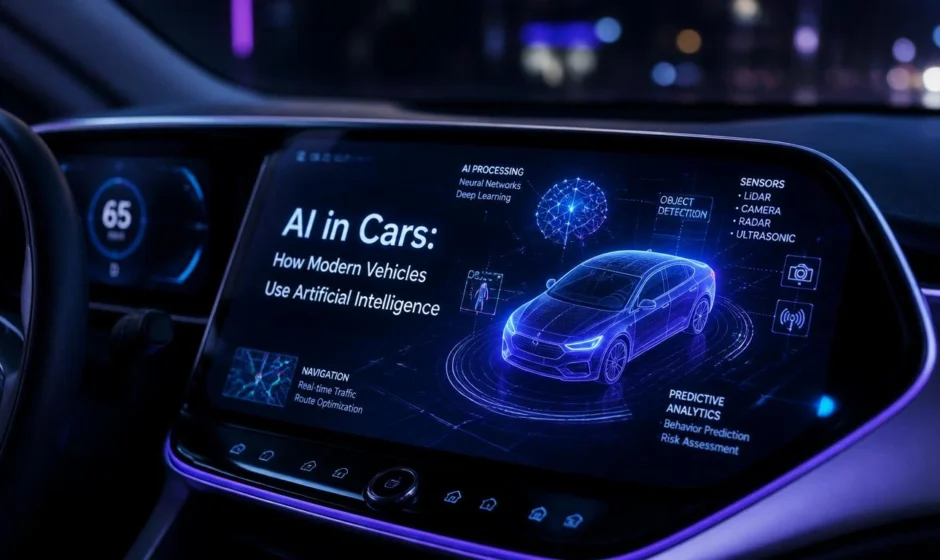

Something genuinely notable happened in the automotive industry in 2026: the competitive focus shifted definitively from a horsepower race to an AI features race. Just a few years ago, electric powertrains looked like the industry’s singular direction; today, the reality is more layered — a hybrid, high-tech landscape where AI capability increasingly defines how a car is marketed and sold, regardless of whether it runs on gas, hybrid, or electric power. Here’s how that AI actually shows up in the cars you can buy right now, building on the broader shift toward software-defined vehicles that makes much of this possible.
Advanced Driver Assistance Systems (ADAS)
The most widespread and mature application of AI in today’s cars is Advanced Driver Assistance Systems, which combine cameras, radar, ultrasonic sensors, and machine-learning software to analyze the environment around the vehicle in real time. Features that felt like science fiction a decade ago — lane centering, adaptive cruise control with full stop-and-go capability, and advanced automated parking — are now standard equipment on many mainstream models. These systems process live sensor data to detect pedestrians, cyclists, and other vehicles, often reacting measurably faster than a human driver can, and can apply automatic braking or corrective steering the instant a potential collision is detected. This is the same technology underpinning the SAE automation levels covered elsewhere in this category — the vast majority of what’s on the road today sits at Level 1 or Level 2 specifically because of how these ADAS systems are designed to require ongoing driver engagement.
Predictive Maintenance
Beyond driving assistance, AI is changing how cars are maintained. Rather than relying on fixed mileage-based service intervals, modern vehicles increasingly use AI to continuously examine data from engine systems, tires, brakes, and other components to spot patterns indicating wear or an impending failure — telling an owner specifically when something needs attention rather than defaulting to a generic schedule. The practical benefit is real: fewer unnecessary service visits, lower long-term ownership costs, and less risk of an unexpected breakdown from a problem that could have been flagged earlier.
Driver Monitoring and Attention Systems
AI-powered inward-facing cameras and sensors now assess driver attention in real time, watching for signs of drowsiness or distraction and issuing alerts when a driver’s focus appears to be drifting from the road. This isn’t a marginal feature — with more than three-quarters of vehicles worldwide now equipped with Level 1 or Level 2 ADAS technology, ensuring drivers actually understand and appropriately use these systems, rather than becoming overly reliant on them, has become a genuine safety consideration in its own right, not just a technology footnote.
AI Voice Assistants and “Copilots”
A newer category of in-car AI is emerging around conversational assistants — AI copilots that respond to natural spoken requests the way a passenger might, handling navigation, climate control, media, and increasingly, answering general questions during a drive. This reflects the same broader shift toward more natural, conversational AI interfaces showing up across consumer technology more broadly, now extending into the car cabin specifically.
How Different Automakers Are Approaching AI Differently
Not every manufacturer is pursuing the same AI philosophy, and the differences are genuinely instructive for buyers trying to understand what they’re actually getting:
- BMW focuses on driver control and support — systems like lane-keeping and adaptive cruise enhance the driving experience while explicitly requiring the driver to remain engaged at all times, rather than pushing toward greater autonomy.
- Tesla aims more directly at autonomous driving capability, with Autopilot (now bundled with Full Self-Driving) requiring active supervision despite its more ambitious branding.
- Mercedes-Benz offers Level 2++ capability today while actively working toward broader Level 3 deployment through Drive Pilot, currently available in limited markets.
- Audi provides Level 2 systems focused primarily on safety, similar in philosophy to BMW’s approach, without an aggressive push toward higher autonomy levels.
This divergence connects to a broader industry pattern worth understanding: it mirrors the same kind of agentic AI evolution happening across technology generally, where systems progress from simple assistance toward greater autonomy at different speeds depending on the company’s specific risk tolerance and regulatory strategy.
What This Means for Car Buyers
For anyone shopping in 2026, understanding a manufacturer’s underlying AI philosophy matters as much as any single feature name on a spec sheet. A buyer who wants maximum driver engagement and a traditional driving feel may prefer BMW or Audi’s more conservative approach, while someone drawn to cutting-edge, frequently updated capability might lean toward Tesla or Mercedes. Predictive maintenance features, meanwhile, are worth asking about regardless of brand, since they can meaningfully reduce long-term ownership costs and unexpected repair surprises — a genuinely practical benefit that doesn’t depend on a manufacturer’s stance on autonomy at all.
The Bottom Line
AI in cars in 2026 spans a genuinely wide range of applications — far beyond just autonomous driving headlines — from real-time safety systems and predictive maintenance to driver monitoring and increasingly natural conversational assistants. The specific way a manufacturer implements AI now says as much about that brand’s philosophy and target buyer as its styling or performance numbers once did, making it a genuinely important factor to understand before choosing which car to buy, not just a marketing checkbox to skim past.
FAQs
What are the most common AI features in cars today?
Advanced Driver Assistance Systems (ADAS) are the most widespread AI application, including adaptive cruise control, lane centering, automated parking, and automatic emergency braking, all powered by cameras, radar, and machine-learning software.
How does AI-powered predictive maintenance work in cars?
AI continuously analyzes data from a vehicle’s engine, tires, brakes, and other components to detect patterns indicating wear or potential failure, alerting owners to specific maintenance needs rather than relying on generic, fixed service intervals.
Do all car brands approach AI and autonomy the same way?
No. BMW and Audi generally focus on driver support while requiring constant engagement, Tesla pushes more aggressively toward autonomous capability, and Mercedes-Benz offers advanced Level 2++ features while working toward broader Level 3 deployment.
What is an AI copilot in a car?
An AI copilot is a conversational voice assistant built into a vehicle that responds to natural spoken requests, handling tasks like navigation, climate control, and media, similar to how general-purpose AI assistants work outside of cars.
Why does a car’s underlying AI philosophy matter when buying?
Understanding whether a manufacturer prioritizes driver engagement or greater autonomy can meaningfully affect the actual driving experience, beyond what any single feature name on a spec sheet might suggest.