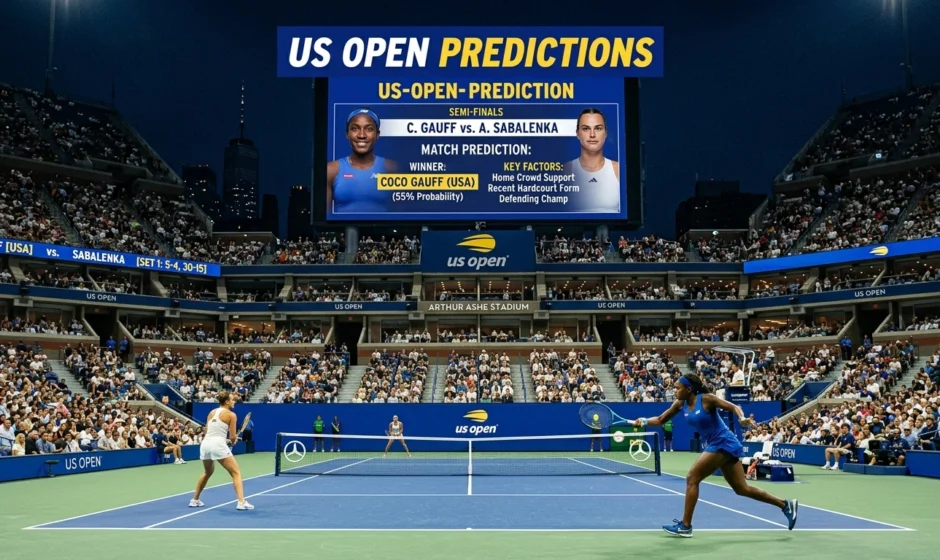

Final Grand Slam of year is underway at Flushing Meadows, running from August 30 through men’s final on September 13. And this year’s field carries genuinely open storylines on both sides of the draw. Building on our full rundown of September’s biggest sporting events. Here’s a complete breakdown of who’s playing for what, and the specific factors worth watching as the tournament progresses.
The Headline Absence: No Jannik Sinner
World No. 1 Jannik Sinner is missing from this year’s tournament entirely, which reshapes the entire men’s draw. With the top-ranked player out, Alexander Zverev enters as the No. 1 seed, having been the most consistent performer at Grand Slams all season. Reaching the Australian Open semifinals, winning the French Open, and finishing runner-up at Wimbledon. Every seed in the men’s draw effectively moves up one position as a direct result of Sinner’s withdrawal.
Why Alcaraz Is the Favorite Despite Being Seeded Second
Carlos Alcaraz returns to defend his title after a four-month layoff. And the betting markets tell an interesting story here. He’s the outright favorite at +250, ahead of top seed Zverev at +300, despite being seeded below him. This is exactly the kind of gap between seeding and actual title probability worth understanding from a competitive standpoint. Seeding reflects ranking points accumulated over a full season, while betting odds reflect a more immediate assessment of current form and talent ceiling. Alcaraz’s talent was never in question; what’s genuinely uncertain is match sharpness after a long absence. Best-of-five-set tennis has a way of exposing gaps in physical conditioning that don’t show up in a player’s first or second match. The real test comes in the second week, when accumulated match minutes start to matter more than raw ability.
Djokovic’s Pursuit of History
Novak Djokovic returns to a tournament he’s won four times, sitting level with Margaret Court on 24 Grand Slam singles titles and chasing a record 25th. At this stage of a legendary career, the specific thing worth watching isn’t raw shot-making. It’s whether he can still manage his physical output across best-of-five matches deep into a two-week event the way he has in years past. Since that management, more than any single skill, has been the defining trait of his longevity at the majors.
Deep Contenders Beyond the Top Two Seeds
Felix Auger-Aliassime and Flavio Cobolli round out the top four seeds, while Alex de Minaur, Daniil Medvedev, and Ben Shelton complete the top eight — though it’s worth noting a real mismatch between seeding and market confidence this year: Medvedev, seeded 7th, sits at considerably longer betting odds (+3500) than lower seeds like Rafael Jódar (12th seed, +1200) and Arthur Fils (17th seed, +1200), the latter fresh off his maiden Masters 1000 title in Cincinnati just before the tournament. That gap between seeding position and actual betting confidence is often a better real-time signal of current form than ranking alone.
The Women’s Draw: Genuine Depth, No Clear Favorite
Aryna Sabalenka enters as the top seed and two-time defending champion, chasing a three-peat, opening her campaign against Camila Osorio. What makes the women’s field this year particularly hard to reduce to a single favorite: all three other 2026 Grand Slam champions are also in the draw alongside Sabalenka, joined by Amanda Anisimova (last year’s finalist), former world No. 5 Zheng Qinwen making a rare appearance, and Naomi Osaka entering as the 13th seed — still a genuinely dangerous hard-court opponent regardless of seeding position. Iga Swiatek and Coco Gauff round out a field with real depth at every level of the draw, not just at the very top.
Notable Storylines and Absences
A few specific threads are worth following beyond the seeded contenders: Venus Williams is competing on a wild card at 46 years old, opening against Sofia Kenin — a genuinely remarkable longevity story regardless of outcome. Emma Raducanu, the tournament’s most famous recent unseeded champion, is absent this year due to a stress fracture, and Nick Kyrgios is also missing from the field. On the qualifying side, 16-year-old Kristina Liutova became the first player born in 2010 to reach a Grand Slam main draw, arriving on a nine-match win streak and a 36-4 record for the year — a name worth watching even in an early-round matchup.
How the Seeding System Actually Works
For anyone newer to how Grand Slam draws function. 32 players are seeded in each singles draw based on rankings from the Monday before the tournament, with the specific rule that no two seeds can meet before the third round. And the top eight seeds are kept apart until the quarterfinals. Designed specifically to prevent top contenders from eliminating each other before the tournament’s final stages. Unseeded players can still absolutely win it all, as Raducanu’s historic run as a qualifier in 2021 famously demonstrated. But the seeding structure is built to make that outcome the exception rather than a regular occurrence.
Summary
This year’s US Open field offers genuine unpredictability on both sides of the draw. A men’s tournament reshaped by Sinner’s absence and Alcaraz’s uncertain match fitness after injury. And a women’s field with realistic depth beyond the top seed rather than one dominant favorite. With a record $108 million prize pool and $5.5 million going to each singles champion. The stakes match the genuine competitive uncertainty this year’s tournament has produced.
Frequently Asked Questions
Why is Alcaraz the betting favorite despite being seeded below Zverev?
Seeding reflects ranking points accumulated over a full season. While betting odds reflect a more immediate read on form and talent ceiling. Alcaraz’s raw ability makes him the market favorite even after a four-month injury layoff, though his actual match fitness remains a genuine question.
Why did Alexander Zverev become the top seed?
World No. 1 Jannik Sinner withdrew from the 2026 US Open entirely, moving every remaining seed up one position and making Zverev, previously ranked second, the tournament’s top seed.
Is Aryna Sabalenka favored to win the women’s title again?
She enters as the top seed and two-time defending champion chasing a three-peat. But this year’s women’s field features genuine depth. Including all three other 2026 Grand Slam champions, making it a harder tournament to reduce to a single clear favorite.
How does US Open seeding actually work?
32 players are seeded in each singles draw based on rankings the Monday before the tournament. No two seeds can meet before the third round. And the top eight seeds are kept apart until the quarterfinals, though unseeded players can still win. As Emma Raducanu demonstrated in 2021.
Who is absent from the 2026 US Open?
World No. 1 Jannik Sinner is missing from the men’s draw. While Emma Raducanu (due to a stress fracture) and Nick Kyrgios are also absent from this year’s tournament.