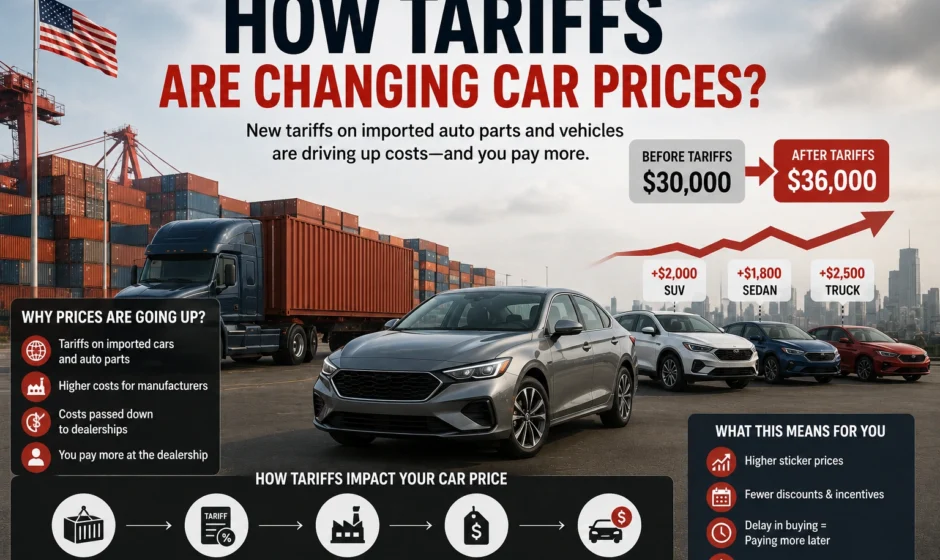

New vehicle prices have continued climbing in 2026, and tariffs on imported vehicles, parts, and raw materials are a significant part of the reason why. This is one of the more disruptive, non-technology forces reshaping the industry this year, tying directly into the broader automotive trends covered elsewhere in this category. And it affects car shopping regardless of whether you’re buying gas, hybrid, or electric.
Where the Tariffs Came From
The current round of auto tariffs stems from a 25% tariff imposed on auto imports, framed by the administration as a measure to protect the American automobile industry against what it described as excessive imports. Noting that roughly half of the cars, SUVs, and light trucks Americans bought in 2024 were imports. And that only around 25% of an average vehicle’s content could be categorized as “Made in America.” Critics within the industry, including analysts and dealer executives, have argued the tariffs are simply too high and are increasingly being passed on to consumers rather than absorbed by manufacturers indefinitely.
The Legal Back-and-Forth Hasn’t Provided Relief
The tariff situation has also gone through real legal turbulence in 2026. On February 20, 2026, the US Supreme Court ruled 6-3 in Learning Resources, Inc. v. Trump that the International Emergency Economic Powers Act (IEEPA) does not grant the president authority to impose tariffs, striking down a set of “reciprocal” tariffs on dozens of trading partners. However, this ruling did not affect the auto-specific tariffs, which were implemented under different statutory authority and remained in place. When a separate temporary tariff authority expired in July 2026, new tariffs were subsequently re-implemented on a broad range of countries under yet another statutory basis meaning car buyers hoping the legal challenges would bring relief have not seen that materialize.
How Much Are Tariffs Actually Costing the Industry?
The financial scale is substantial. One industry analysis estimated automakers faced a combined $10.6 billion in tariff-related duties on imported vehicles, parts, and materials like aluminum and steel through the end of October 2025 alone. Individual manufacturer impacts have been significant and public. GM reported a $3.1 billion earnings hit in 2025 tied partly to tariffs, with total impacts projected to reach $4-5 billion. European brands including BMW, Mercedes-Benz, and Volkswagen face an estimated combined $6 billion exposure from EU-assembled luxury vehicles. And Hyundai-Kia is reportedly carrying a $2.07 billion burden tied to South Korean imports and EV battery components.
How This Is Showing Up in Actual Prices
For much of 2025, automakers largely absorbed these costs rather than passing them directly to consumers. And dealers have reportedly absorbed roughly 4.5% of the tariff impact themselves through discounts and margin compression. That absorption is proving unsustainable. Kelley Blue Book reported the average new vehicle transaction price rose in April 2026 compared to March, up 1.8% year-over-year. And Cars.com reported new vehicle prices jumped by an average of $1,315 in the first quarter of 2026 compared to vehicles added to inventory during the same period a year earlier. Destination fees have climbed sharply too domestic brand delivery fees now average $2,189. A 25% increase from 2025 alone, following an even steeper 163% jump the year before.
Some manufacturers have publicly disputed how much of these increases trace directly to tariffs versus other factors. Kia, for instance, attributed a roughly $1,300 price increase on the 2026 Sportage to new content and features rather than tariff costs specifically. Though industry analysts have expressed skepticism about that framing given the broader pattern across the market.
The Indirect Effect on Used Car Prices
Tariffs don’t directly apply to used vehicles already sitting on dealer lots. But the effect still ripples into the used market. As new cars become more expensive, more shoppers shift their attention toward used vehicles instead. And that additional demand can support higher used car prices even without any direct tariff applied to those specific vehicles. This adds another layer worth considering alongside the current wave of used EV lease returns covered elsewhere in this category. A buyer’s market for used EVs specifically, even as used car prices more broadly face some tariff-driven upward pressure.
What This Means for Car Buyers Right Now
- New vehicle supply is also tightening: Down roughly 3.5% year-over-year in the first quarter of 2026. According to Cars.com meaning less inventory and fewer dealer incentives to offset rising prices.
- Even domestically assembled vehicles aren’t fully insulated: Since nearly every vehicle built in the US still relies on at least some imported parts and components subject to tariff costs.
- Comparing total monthly payment, not just sticker price, matters more than ever — your actual payment depends on down payment, loan term, interest rate, and fees, several of which (like destination fees) have also been climbing independently of the vehicle’s base price.
- Repair costs may rise too, if replacement parts are imported or affected by the same higher material costs driving up new vehicle prices.
Ending Lines
Tariffs have become one of the most direct forces pushing new car prices higher in 2026. And the legal challenges working through the courts so far haven’t provided relief for the auto-specific tariffs driving much of that increase. With automakers and dealers reaching the limits of how much cost they can absorb without passing it to consumers, buyers are likely to see continued upward pressure on both new and, indirectly, used vehicle prices for the remainder of the year making it worth comparing total ownership cost carefully rather than assuming any one powertrain type or vehicle segment is immune to the broader pricing trend.
FAQs
Why have new car prices gone up so much in 2026?
Tariffs on imported vehicles, parts, and materials like aluminum and steel are a major factor, alongside rising destination fees and tightening vehicle supply, with automakers and dealers increasingly passing these added costs on to consumers.
Did the Supreme Court ruling on tariffs lower car prices?
No. While the Supreme Court struck down certain “reciprocal” tariffs implemented under the IEEPA in February 2026. The auto-specific tariffs were implemented under different statutory authority and were not affected by that ruling.
How much have tariffs cost the auto industry?
One industry estimate put combined tariff-related costs to automakers at $10.6 billion through the end of October 2025. With individual manufacturers like GM, BMW, Mercedes-Benz, and Hyundai-Kia reporting billions of dollars in tariff-related impacts.
Do tariffs affect used car prices too?
Indirectly, yes. Tariffs don’t directly apply to vehicles already on used car lots. But as tariffs push new car prices higher, more shoppers turn to the used market. And that increased demand can support higher used car prices as a result.
Are domestically manufactured cars protected from tariff-related price increases?
Not entirely. Even vehicles assembled in the US typically rely on at least some imported parts and components. Meaning they can still be affected by tariff costs even though they aren’t imported as complete vehicles